
Mathematical Reasoning in Jemparingan: An Ethnographic Study of Ratio, Acute Angles, and Integer Operations in a Javanese Archery Tradition
DOI:
https://doi.org/10.30862/jhm.v9i1.1247Keywords:
Ethnomathematics , Javanese Culture , Jemparingan, Mathematical Concepts, Mathematics LearningAbstract
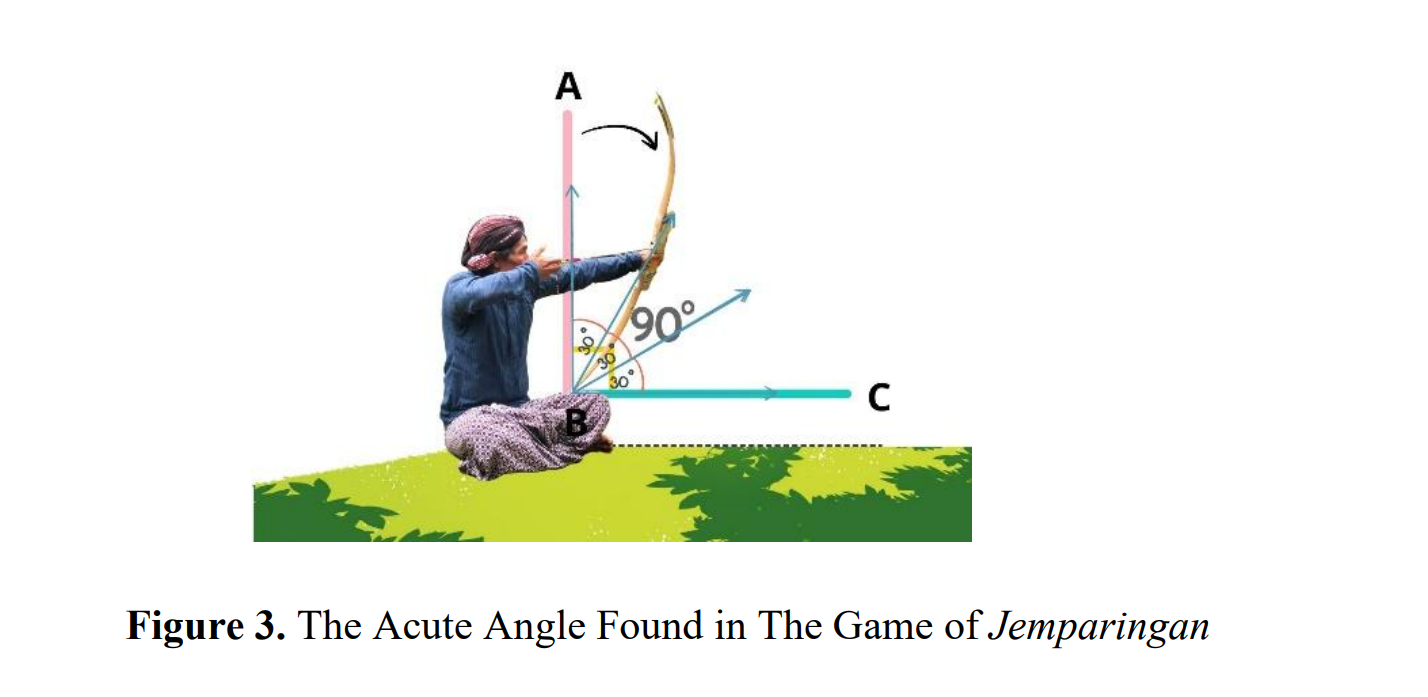
Traditional cultural practices have become a major focus in the study of ethnomathematics. However, there is still relatively little empirical research that systematically identifies the mathematical concepts embedded in traditional Javanese games. Therefore, this study aims to identify and analyze the mathematical concepts embedded in Jemparingan , a traditional Yogyakarta archery game, and to examine its relevance to mathematics learning. This research employed a qualitative ethnographic approach. Data were collected through participatory observation, field documentation, and semi-structured interviews with Jemparingan practitioners. The data was analyzed using thematic analysis, which includes data organization, in-depth reading and data recording, coding, and data interpretation. The findings revealed three mathematical concepts: proportional relationships in equipment measurement, acute angles in bow positioning, and integer operations in score calculation. These patterns are closely associated with the Javanese philosophy of hening-hening (inner calmness), which emphasizes calmness and balance. Overall, this study contributes to ethnomathematics by providing empirical evidence that traditional games can function as authentic representations of mathematical thinking while supporting appreciation of local cultural heritage. These findings encourage educators to consider the integration of local culture into more meaningful mathematics instruction.
References
Ahmed, S. K., Mohammed, R. A., Nashwan, A., Ibrahim, R. H., Abdalla, A. Q., M. Amin, B. M., & Khdhir, R. M. (2025). Using thematic analysis in qualitative research. SSRN Electronic Journal. https://doi.org/10.2139/ssrn.5222482
Amsikan, S., Deda, Y. N., & Sintia, A. (2023). Ethnomathematics Exploration of Kaneka and Mariam Tradional Games in Nangapanda, Nusa Tenggara Timur Culture. Journal of Honai Math, 6(2), 88–98. Retrieved from https://journalfkipunipa.org/index.php/jhm/issue/view/64
Ashar, Sitti Mania, Misykat malik Ibrahim, St. Syamsudduha, Sadaruddin, & Anita Candra Dewi. (2024). The Impact of Traditional Games on Social-Emotional Development: A Comprehensive Review of Existing Research. Journal of Learning and Development Studies, 4(2), 39–51. https://doi.org/10.32996/jlds.2024.4.2.5
Bostanci, Ö., Kabadayi, M., Mayda, M. H., Yilmaz, A. K., & Yilmaz, C. (2019). The differential impact of several types of sports on pulmonary functions and respiratory muscle strength in boys aged 8-12. Isokinetics and Exercise Science, 27(4), 307–312. https://doi.org/10.3233/IES-192105
D’Ambrosio, U. (2001). General remarks on ethnomathematics. ZDM - International Journal on Mathematics Education, 33(3), 67–69. https://doi.org/10.1007/BF02655696
Đan, N. N., & Luân, N. N. (2025). SỬ DỤNG ĐỒ DÙNG TRỰC QUAN TRONG DẠY HỌC MÔN TOÁN LỚP 4: MỘT NGHIÊN CỨU THỰC NGHIỆM. Tạp Chí Khoa Học, 22(1). https://doi.org/10.54607/hcmue.js.22.1.4040(2025)
Deda, Y. N., & Disnawati, H. (2024). Ethnomathematical investigation of traditional games for cultural preservation in the Indonesia-Timor Leste border region. Journal of Honai Math, 7(1), 19-36.
Deda, Y. N., Rosa, M., Disnawati, H., & Tamur, M. (2024). Ethnomathematical perspectives on Galah Asin: Investigating the mathematical and cultural significance of a traditional game. Jurnal Elemen, 10(3), 516–532. https://doi.org/10.29408/jel.v10i3.25467
Haas Prieto, V., & Troncoso, C. P. (2025). La valoración del juego en el aula universitaria. European Public & Social Innovation Review, 10, 1–15. https://doi.org/10.31637/epsir-2025-1609
Ibarra, M. J., Moscoso, B. B., Aiquipa, E. G., Madariaga, R. E. C., Huacoto, J. L. D., & Bendezu, M. P. L. (2020). A systematic literature review of empirical evidence on Serious Game for Mathematics Learning. In Proceedings of the 15th Latin American Conference on Learning Technologies, LACLO 2020. Institute of Electrical and Electronics Engineers Inc. https://doi.org/10.1109/LACLO50806.2020.9381154
Islammeiliani, D., Sularti, S., Handayani, D., & Aeni, K. (2021). The Implementation of Jemparingan Games in Kulon Progo Regency, Yogyakarta (A Case Study at Pembina Wates State Kindergarten). Journal of Primary Education, 10(1), 44–51. Retrieved from https://journal.unnes.ac.id/sju/index.php/jpe
Khasanah, M., Khalil, I. A., & Prahmana, R. C. I. (2023). An inquiry into ethnomathematics within the framework of the traditional game of Congklak. Journal of Honai Math, 6(2), 175-188.
Kushnir, I. (2025). Thematic analysis in the area of education: a practical guide. Cogent Education, 12(1). https://doi.org/10.1080/2331186X.2025.2471645
Lestari, D. P., Anwar, L., Sa’dijah, C., Rahim, S. S. A., & Hafiizh, M. (2024). Cultural Integration on Geometry Lesson: The Impact of Traditional Game-Based Learning on Students’ Creative Thinking. Journal of Ecohumanism, 3(8), 12285–12299. https://doi.org/10.62754/joe.v3i8.5834
Li, K., Wijaya, T. T., Chen, X., & Harahap, M. S. (2024). Exploring the factors affecting elementary mathematics teachers’ innovative behavior: an integration of social cognitive theory. Scientific Reports, 14(1). https://doi.org/10.1038/s41598-024-52604-4
Liang, H., & Sitthiworachart, J. (2023). Game-based learning to enhance students logical thinking abilities in primary school Mathematics. In ACM International Conference Proceeding Series (pp. 86–93). Association for Computing Machinery. https://doi.org/10.1145/3629296.3629336
Močinić, S. N., & Brussich, T. (2023). Traditional game : intangible cultural heritage. Knowledge – International Journal, 58(2), 311–316.
Mwinsa, G. M., & Dagada, M. (2025). Play-based learning: A pedagogical approach for social skills development in ECE learners in Zambia. Social Sciences and Humanities Open, 11. https://doi.org/10.1016/j.ssaho.2025.101396
Oktavia, R., Riwayati, S., & Syofiana, M. (2025). Etnomatematika dalam permainan tradisional Ingkau di Bengkulu Tengah. Phythagoras : Jurnal Program Studi Pendidikan Matematika, 14(2), 247–258. https://doi.org/10.33373/pyth.v14i2.7850
Rakimahwati, Ismet, S., Zainul, R., Roza, D., & Mukminin, A. (2022). The Development of the Educational Game to Improve Logical/ Mathematical Intelligence. Journal of Higher Education Theory and Practice, 22(7), 11–19. https://doi.org/10.33423/jhetp.v22i7.5266
Robawati, Setiawan, R., & Wiraya, A. (2025). Analysis of Problem-Solving Ability with Ethnomathematics Nuances in the Marble Game in View of Students’ Learning Style. Journal of Urban Mathematics Education, 18(1), 34–64. https://doi.org/10.21423/jume-v18i1a657
Rosa, M., & Orey, D. C. (2016). State of the Art in Ethnomathematics BT - Current and Future Perspectives of Ethnomathematics as a Program. In M. Rosa, U. D’Ambrosio, D. C. Orey, L. Shirley, W. V. Alangui, P. Palhares, & M. E. Gavarrete (Eds.), Current and Future Perspectives of Ethnomathematics as a Program (pp. 11–37). Springer International Publishing. Retrieved from https://doi.org/10.1007/978-3-319-30120-4_3
Schoenherr, J., Strohmaier, A. R., & Schukajlow, S. (2024, November 1). Learning with visualizations helps: A meta-analysis of visualization interventions in mathematics education. Educational Research Review. Elsevier Ltd. https://doi.org/10.1016/j.edurev.2024.100639
Setyowati, E., Nurcahyo, A., Sunaryo, I., & Jaya, H. P. (2025). Ethnomathematics in The Bekel Ball Game to Introduce The Concept of Multiples. In AIP Conference Proceedings (Vol. 3142). American Institute of Physics. https://doi.org/10.1063/5.0262198
Souza Júnior, M. de, Souza, M. do C. da S., Pinheiro, M. J. S. M., Santos, K. P. de V. dos, Pereira, W. M. M., Oliveira, M. P. da S., & Freitas, J. V. S. de. (2023). Etnografia como método de pesquisa em Ciências da Educação. Research, Society and Development, 12(13), e63121344223. https://doi.org/10.33448/rsd-v12i13.44223
Sunni, J. F., & Pradipta, T. R. (2024). Integration of Ethnomathematics in Galasin Game on The Teaching Material of High School Students. Unnes Journal of Mathematics Education, 13(2), 104–114. https://doi.org/10.15294/eyqekw06
Supriadi, S. (2019). Didactic design of sundanese ethnomathematics learning for primary school students. International Journal of Learning, Teaching and Educational Research, 18(11), 154–175. https://doi.org/10.26803/ijlter.18.11.9
Taheri, L., & Chahian, G. (2015). Restoration of traditional children’s play in Iranian nomadic societies (Case study of Kohgilouyeh and Boyer Ahmad). Children, 2(2), 211–227. https://doi.org/10.3390/children2020211
Tampubolon, T., Sibarani, S., Zuhri, Efendi, Zakiah, N., & Zaini, H. (2023). Ethnomathematics Learning to Improve Students’ Understanding for Numeracy Concepts. JPI (Jurnal Pendidikan Indonesia), 12(2), 358–366. https://doi.org/10.23887/jpiundiksha.v12i2.60716
Umi, S., & Pambudi, P. (2025). Digital Preservation of Traditional Games: The Role of Community Pioneers in Yogyakarta. Knowledge Garden, 3(1), 26–47. https://doi.org/10.21776/ub.knowledgegarden.2025.3.1.33
Winardi, M. P. A., & Jupri, A. (2025). Implementation of folk games ethnomathematics in mathematics learning: A systematic literature review. Research and Development in Education (RaDEn), 5(2), 796–810. https://doi.org/10.22219/raden.v5i2.41254
Yücesan, Y., Portugal, G., & Figueiredo, M. (2023). Cultural heritage in early childhood education: a systematic review. European Early Childhood Education Research Journal, 31(6), 866–883. https://doi.org/10.1080/1350293X.2023.2207031
Zayyadi, M., Surahmi, E., Aini, S. D., & Hidayat, D. (2025). Ethnomathematics-based traditional games as a pedagogical approach to enhance logical-mathematical intelligence. Jurnal Elemen, 11(1), 225–244. https://doi.org/10.29408/jel.v11i1.28350
Zuhri, Z., Dewi, S. V., Kusuma, J. W., Rafiqoh, S., Mahuda, I., & Hamidah, H. (2023). Implementation of Ethnomathematics Strategy in Indonesian Traditional Games as Mathematics Learning Media. Journal of Innovation in Educational and Cultural Research, 4(2), 294–302. https://doi.org/10.46843/jiecr.v4i2.613
Downloads
Published
How to Cite
Issue
Section
License
Copyright (c) 2026 Novia Ahlul Janah, Dwi Astuti Astuti, Rully Charitas Indra Prahmana

This work is licensed under a Creative Commons Attribution-NonCommercial-ShareAlike 4.0 International License.
License and Copyright Agreement
In submitting the manuscript to the journal, the authors certify that:
- They are authorized by their co-authors to enter into these arrangements.
- The work described has not been formally published before, except in the form of an abstract or as part of a published lecture, review, thesis, or overlay journal. Please also carefully read Journal of Honai Math Posting Your Article Policy at http://journalfkipunipa.org/index.php/jhm/about
- That it is not under consideration for publication elsewhere,
- That its publication has been approved by all the author(s) and by the responsible authorities – tacitly or explicitly – of the institutes where the work has been carried out.
- They secure the right to reproduce any material that has already been published or copyrighted elsewhere.
- They agree to the following license and copyright agreement.
Copyright
Authors who publish with Journal of Honai Math agree to the following terms:
- Authors retain copyright and grant the journal right of first publication with the work simultaneously licensed under a Creative Commons Attribution License (CC BY-NC-SA 4.0) that allows others to share the work with an acknowledgment of the work's authorship and initial publication in this journal.
- Authors are able to enter into separate, additional contractual arrangements for the non-exclusive distribution of the journal's published version of the work (e.g., post it to an institutional repository or publish it in a book), with an acknowledgment of its initial publication in this journal.
- Authors are permitted and encouraged to post their work online (e.g., in institutional repositories or on their website) prior to and during the submission process, as it can lead to productive exchanges, as well as earlier and greater citation of published work.




