
Relationships among Achievement Emotions, Mathematical Problem-Solving Beliefs, and Metacognition in Indonesian High School Students
DOI:
https://doi.org/10.30862/jhm.v8i3.885Keywords:
achievement motivation, cognitive appraisals, emotional regulation, problem solving strategies , self-efficacy in mathematicsAbstract
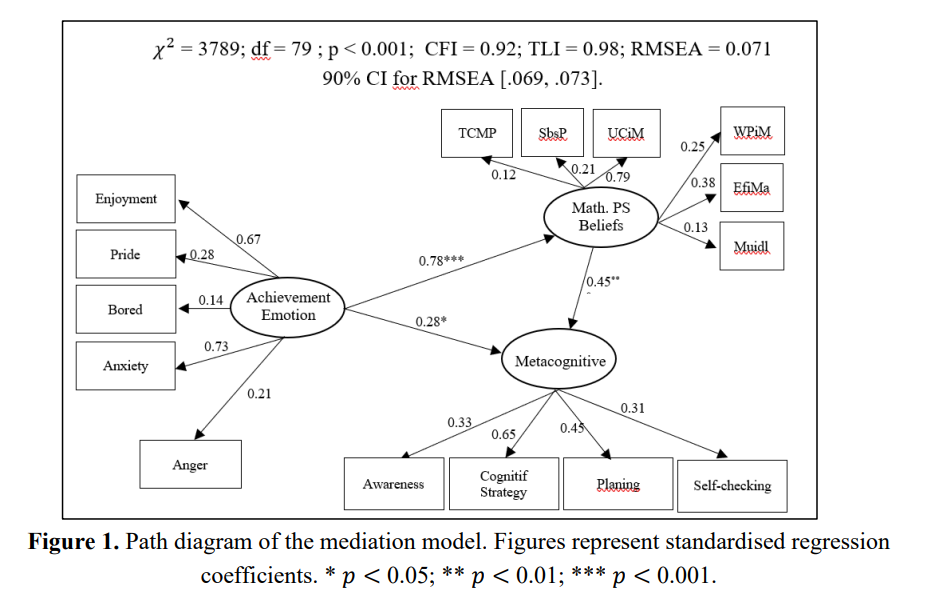
Mathematics learning is influenced not only by cognitive factors but also by affective components such as emotions, beliefs, and metacognition. However, limited research has explored how achievement emotions interact with mathematical problem-solving beliefs and metacognition, particularly among Indonesian students. This study examine the relationships between achievement emotions, mathematical problem-solving beliefs, and metacognition in 750 Indonesian high school students from 10th and 11th grades. The Participants completed questionnaires measuring achievement emotions (in classroom and test contexts), mathematical problem-solving beliefs, and metacognitive components awareness, cognitive strategies, planning, and self-checking. The findings demonstrated substantial associations among these elements: positive emotions, particularly enjoyment and pride, reinforced both problem-solving beliefs and metacognition, while negative emotions like anxiety and anger impaired them during mathematical problem-solving tasks. The outcomes emphasize the critical role of developing positive emotions such as enjoyment and pride while diminishing negative emotions, particularly anxiety, in enhancing students' metacognitive skills and mathematical problem-solving performance. In addition, this study supports the Control-Value Theory of Achievement Emotions by empirically validating that mathematical problem-solving beliefs act as intermediaries between emotions and metacognitive processes. This contribution offers new theoretical insight into how affective factors shape higher-order cognitive regulation, providing a novel understanding of the emotional foundations of mathematics learning in the Indonesian context. These findings emphasize the importance of emotions in shaping students' engagement with mathematics and highlight the need for teaching strategies that promote emotional well-being alongside cognitive development.
References
Acosta-Gonzaga, E., & Ramirez-Arellano, A. (2021). The Influence of Motivation, Emotions, Cognition, and Metacognition on Students’ Learning Performance: A Comparative Study in Higher Education in Blended and Traditional Contexts. SAGE Open, 11(2), 1–12. https://doi.org/10.1177/21582440211027561
Avry, S., Chanel, G., Bétrancourt, M., & Molinari, G. (2020). Achievement appraisals, emotions and socio-cognitive processes: How they interplay in collaborative problem-solving? Computers in Human Behavior, 107(January). https://doi.org/10.1016/j.chb.2020.106267
Barnes, A. (2020). Enjoyment in learning mathematics: its role as a potential barrier to children’s perseverance in mathematical reasoning. Educational Studies in Mathematics. https://doi.org/10.1007/s10649-020-09992-x
Bieleke, M., Goetz, T., Yanagida, T., Botes, E., Frenzel, A. C., & Pekrun, R. (2023). Measuring emotions in mathematics: the Achievement Emotions Questionnaire Mathematics (AEQ-M). ZDM - Mathematics Education, 55(2), 269–284. https://doi.org/10.1007/s11858-022-01425-8
Buratti, S., & Allwood, C. M. (2015). Regulating metacognitive processes support for a meta-metacognitive ability. In A. Peña-Ayala (Ed.), Metacognition: Fundaments, Applications, and Trends (pp. 17–38). Switzerland: Springer International Publishing.
Butz, N. T., Stupnisky, R. H., Pekrun, R., Jensen, J. L., & Harsell, D. M. (2016). The Impact of Emotions on Student Achievement in Synchronous Hybrid Business and Public Administration Programs: A Longitudinal Test of Control-Value Theory*. Decision Sciences Journal of Innovative Education, 14(4), 441–474. https://doi.org/10.1111/dsji.12110
Debellis, V. A., & Goldin, G. A. (2006). Affect and meta-affect in mathematical problem solving: A representational perspective. Educational Studies in Mathematics, 63(2), 131–147. https://doi.org/10.1007/s10649-006-9026-4
Desoete, A. (2008). Multi-method assessment of metacognitive skills in elementary school children: How you test is what you get. Metacognition and Learning, 3(3), 189–206. https://doi.org/10.1007/s11409-008-9026-0
Desoete, A., Roeyers, H., & Buysse, A. (2001). Metacognition and mathematical problem solving in grade 3. Journal of Learning Disabilities, 34(5), 435–447. https://doi.org/10.1177/002221940103400505
Di Leo, I., Muis, K. R., Singh, C. A., & Psaradellis, C. (2019). Curiosity… Confusion? Frustration! The role and sequencing of emotions during mathematics problem solving. Contemporary Educational Psychology, 58, 121–137. https://doi.org/10.1016/j.cedpsych.2019.03.001
Efklides, A., Schwartz, B. L., & Brown, V. (2011). Does metacognition play a role? In D. H. Schunk & J. A. Greene (Eds.), Handbook of Self-Regulation of Learning and Performance. New York: Routledge. https://doi.org/10.4324/9780203839010
Franz-Odendaal, T. A., Blotnicky, K., French, F., & Joy, P. (2016). Experiences and Perceptions of STEM Subjects, Careers, and Engagement in STEM Activities Among Middle School Students in the Maritime Provinces. Canadian Journal of Science, Mathematics and Technology Education, 16(2), 153–168. https://doi.org/10.1080/14926156.2016.1166291
Goetz, T., Cronjaeger, H., Frenzel, A. C., Lüdtke, O., & Hall, N. C. (2010). Academic self-concept and emotion relations: Domain specificity and age effects. Contemporary Educational Psychology, 35(1), 44–58. https://doi.org/10.1016/j.cedpsych.2009.10.001
Goetz, T., Pekrun, R., Hall, N., & Haag, L. (2006). Academic emotions from a social-cognitive perspective: Antecedents and domain specificity of students’ affect in the context of Latin instruction. British Journal of Educational Psychology, 76(2), 289–308. https://doi.org/10.1348/000709905X42860
Gomez-chacon, I. M. (2000). Affective Influences in the Knowledge of Mathematics. Educational Studies in Mathematics, 43(2), 149–168.
Hannula, M. S. (2015). Emotion in problem solving. In S. J. Cho (Ed.), Selected regular lectures from the 12th international congress on mathematical education (pp. (pp. 269–288). Springer International Publishing.
Kossahdasabitah, A., & Zulkarnaen, R. (2025). Metacognition and Achievement Emotions in Mathematical Modelling Competency: A Confirmatory Factor Analysis of Their Interplay. Mosharafa: Jurnal Pendidikan Matematika, 14(1), 209–222. https://doi.org/10.31980/mosharafa.v14i1.2066
Kwon, H., Capraro, R. M., & Capraro, M. M. (2021). When I Believe, I Can: Success STEMs from My Perceptions. Canadian Journal of Science, Mathematics and Technology Education, 21(1), 67–85. https://doi.org/10.1007/s42330-020-00132-4
Layco, E. P. (2020). The Role of Metacognition and its Interaction on Students’ Negative Academic Emotions towards Their Academic Buoyancy and Achievement in Mathematics. Universal Journal of Educational Research, 8(12A), 7500–7510. https://doi.org/10.13189/ujer.2020.082534
Leder, G., & Grootenboer, P. (2005). Affect and mathematics education. Mathematics Education Research Journal, 17(2), 1–8. https://doi.org/10.1007/BF03217413
Leiss, D., Schukajlow, S., Blum, W., Messner, R., & Pekrun, R. (2010). The Role of the Situation Model in Mathematical Modelling—Task Analyses, Student Competencies, and Teacher Interventions. https://doi.org/10.1007/s13138-010-0006-y
Li, Q., Cho, H., Cosso, J., & Maeda, Y. (2021). Relations Between Students’ Mathematics Anxiety and Motivation to Learn Mathematics: a Meta-Analysis. Educational Psychology Review, 33(3), 1017–1049. https://doi.org/10.1007/s10648-020-09589-z
Lichtenfeld, S., Pekrun, R., Stupnisky, R. H., Reiss, K., & Murayama, K. (2012). Measuring students’ emotions in the early years: The Achievement Emotions Questionnaire-Elementary School (AEQ-ES). Learning and Individual Differences, 22(2), 190–201. https://doi.org/10.1016/j.lindif.2011.04.009
Muis, K. R., Psaradellis, C., Lajoie, S. P., Di Leo, I., & Chevrier, M. (2015). The role of epistemic emotions in mathematics problem solving. Contemporary Educational Psychology, 42, 172–185. https://doi.org/10.1016/j.cedpsych.2015.06.003
O’Neil, H. F., & Abedi, J. (1996). Reliability and validity of a state metacognitive inventory: Potential for alternative assessment. Journal of Educational Research, 89(4), 234–245. https://doi.org/10.1080/00220671.1996.9941208
Peixoto, F., Sanches, C., Mata, L., & Monteiro, V. (2016). “How do you feel about math?”: relationships between competence and value appraisals, achievement emotions and academic achievement. European Journal of Psychology of Education. https://doi.org/10.1007/s10212-016-0299-4
Pekrun, R. (2006). The control-value theory of achievement emotions: Assumptions, corollaries, and implications for educational research and practice. Educational Psychology Review, 18(4), 315–341. https://doi.org/10.1007/s10648-006-9029-9
Pekrun, R., Cusack, A., Murayama, K., Elliot, A. J., & Thomas, K. (2014). The power of anticipated feedback: Effects on students’ achievement goals and achievement emotions. Learning and Instruction, 29, 115–124. https://doi.org/10.1016/j.learninstruc.2013.09.002
Pekrun, R., Goetz, T., Titz, W., Perry, R. P., Pekrun, R., Goetz, T., Titz, W., & Perry, R. P. (2002). Academic Emotions in Students’ Self-Regulated Learning and Achievement : A Program of Qualitative and Quantitative Research. Educational Psychologist, 37(2), 91–105. https://doi.org/10.1207/S15326985EP3702
Pekrun, R., & Stephens, E. J. (2010). Achievement Emotions: A Control-Value Approach. Social and Personality Psychology Compass, 4(4), 238–255. https://doi.org/10.1111/j.1751-9004.2010.00259.x
Pekrun, R., Lichtenfeld, S., Marsh, H. W., Murayama, K., & Goetz, T. (2017). Achievement emotions and academic performance: Longitudinal models of reciprocal effects. Child Development, 88(5), 1653–1670. https://doi.org/10.1111/cdev.12704
Schukajlow, S., Rakoczy, K., & Pekrun, R. (2023). Emotions and motivation in mathematics education: Where we are today and where we need to go. ZDM - Mathematics Education, 55(2), 249–267. https://doi.org/10.1007/s11858-022-01463-2
Sintema, E. J., & Mosimege, M. (2023). High School Students’ Beliefs about Mathematical Problem Solving: A Cluster Analysis. Mathematics Teaching-Research Journal, 15(1), 68–83.
Stylianides, A. J., & Stylianides, G. J. (2014). Impacting positively on students’ mathematical problem solving beliefs: An instructional intervention of short duration. Journal of Mathematical Behavior, 33(1), 8–29. https://doi.org/10.1016/j.jmathb.2013.08.005
Tarricone, P. (2011). The taxonomy of metacognition. In The Taxonomy of Metacognition. New York, NY: Taylor & Francis Group.
Trigueros, R., Aguilar-Parra, J. M., Lopez-Liria, R., Cangas, A. J., González, J. J., & Álvarez, J. F. (2020). The Role of Perception of Support in the Classroom on the Students’ Motivation and Emotions: The Impact on Metacognition Strategies and Academic Performance in Math and English Classes. Frontiers in Psychology, 10, 2794. https://doi.org/10.3389/fpsyg.2019.02794
Tugade, M. M., & Fredrickson, B. L. (2004). Resilient Individuals Use Positive Emotions to Bounce Back From Negative Emotional Experiences. Journal of Personality and Social Psychology, 86(2), 320–333. https://doi.org/10.1037/0022-3514.86.2.320
Van der Beek, J. P. J., Van der Ven, S. H. G., Kroesbergen, E. H., & Leseman, P. P. M. (2024). How emotions are related to competence beliefs during mathematical problem solving: Differences between boys and girls. Learning and Individual Differences, 109(December 2023), 102402. https://doi.org/10.1016/j.lindif.2023.102402
Winne, P. H. (1997). Experimenting to Bootstrap Self-Regulated Learning. Journal of Educational Psychology, 89(3), 397–410. https://doi.org/10.1037/0022-0663.89.3.397
Zulkarnaen, R. (2018). Peningkatan kemampuan pemodelan dan penalaran matematis serta academic self-concept siswa SMA melalui interpretation-construction design model. Disertasi, SPs Universitas Pendidikan Indonesia.
Zulkarnaen, R., & Ruli, R. M. (2023). Efektivitas Self-Determination Theory Dalam Perilaku Pemecahan Masalah Matematis Siswa. Jurnal Pembelajaran Matematika Inovatif, 6(4), 1547–1560. https://doi.org/10.22460/jpmi.v6i4.17962
Zulkarnaen, R., & Dewi Nur, I. R. (2024). Achievement Emotion in Matemathics Learning: Meta-Regression. Mosharafa: Jurnal Pendidikan Matematika, 13(3), 829–848. https://doi.org/10.31980/mosharafa.v13i3.2068
Downloads
Published
How to Cite
Issue
Section
License
Copyright (c) 2026 Gida Kadarisma, Rafiq Zulkarnain

This work is licensed under a Creative Commons Attribution-NonCommercial-ShareAlike 4.0 International License.
License and Copyright Agreement
In submitting the manuscript to the journal, the authors certify that:
- They are authorized by their co-authors to enter into these arrangements.
- The work described has not been formally published before, except in the form of an abstract or as part of a published lecture, review, thesis, or overlay journal. Please also carefully read Journal of Honai Math Posting Your Article Policy at http://journalfkipunipa.org/index.php/jhm/about
- That it is not under consideration for publication elsewhere,
- That its publication has been approved by all the author(s) and by the responsible authorities – tacitly or explicitly – of the institutes where the work has been carried out.
- They secure the right to reproduce any material that has already been published or copyrighted elsewhere.
- They agree to the following license and copyright agreement.
Copyright
Authors who publish with Journal of Honai Math agree to the following terms:
- Authors retain copyright and grant the journal right of first publication with the work simultaneously licensed under a Creative Commons Attribution License (CC BY-NC-SA 4.0) that allows others to share the work with an acknowledgment of the work's authorship and initial publication in this journal.
- Authors are able to enter into separate, additional contractual arrangements for the non-exclusive distribution of the journal's published version of the work (e.g., post it to an institutional repository or publish it in a book), with an acknowledgment of its initial publication in this journal.
- Authors are permitted and encouraged to post their work online (e.g., in institutional repositories or on their website) prior to and during the submission process, as it can lead to productive exchanges, as well as earlier and greater citation of published work.




