
Bridging abstract formulas and real-world applications: Developing grade 10 learners’ conceptual understanding of cylinders in South African mathematics classroom
DOI:
https://doi.org/10.30862/jhm.v9i2.1311Keywords:
Digital simulations, Eastern cape mathematics, Geometry education, Real-world applicationsAbstract
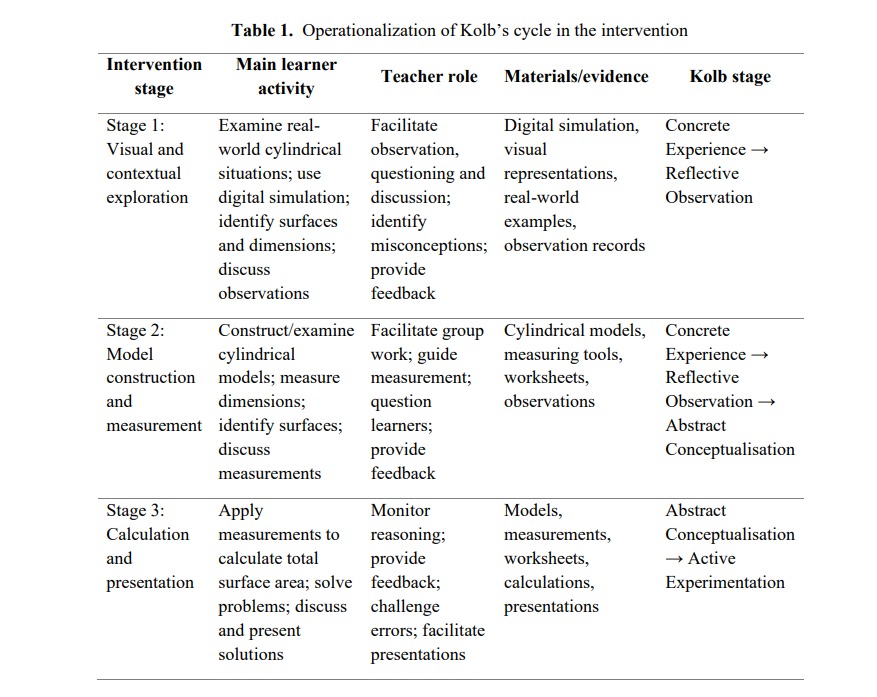
Understanding geometric formulas conceptually remains a persistent challenge for secondary school learners, particularly when mathematical representations are disconnected from familiar real-world contexts. This study investigated the extent to which real-world applications could enhance Grade 10 learners’ conceptual understanding of the total surface area of a cylinder in the Eastern Cape, South Africa. Guided by Kolb’s experiential learning theory, the study employed a mixed-method case study design involving 39 mathematics learners. Quantitative data were obtained through pre-test and post-test measures administered before and after a three-step learning intervention incorporating digital simulations and hands-on construction of cylindrical models. Qualitative data were generated through classroom observations and semi-structured interviews with nine purposively selected learners. Quantitative analysis using a paired-samples t-test indicated a statistically significant improvement in learners’ performance following the intervention, t(38) = 6.30, p < 0.001, with a 35.1% increase in the mean score and a large effect size (Cohen’s d = 1.01). Qualitative analysis identified four interrelated themes: enhanced conceptual understanding, increased motivation through contextualised learning, development of transferable problem-solving skills, and the value of collaborative and visual learning approaches. Collectively, the findings indicate that connecting abstract geometric formulas with tangible cylindrical objects can support learners in developing more meaningful conceptual understandings and reduce misconceptions associated with formula-based reasoning. The study provides empirical evidence that experiential, application-oriented mathematics instruction can strengthen conceptual learning and learner agency, particularly in under-resourced educational contexts in South Africa.
References
Agyare, R.Y., Kaczmarek, T., Leclerc, C., Puozaa, D.K., Tengey, T.K., Bonsu, S.K., Kombiok, J.M., Causse, S., Guillerminet, T., Kena, A.W. and Adjebeng-Danquah, J., (2025). Revealing Ghana’s unique fonio genetic diversity: leveraging farmers knowledge for sustainable conservation and breeding strategies. Genetic Resources and Crop Evolution, 72(1), 235-253. https://doi.org/10.1007/s10722-024-02076-7
Alrashdi, Y., (2023). Understanding teachers’ instructional strategies that apply real-world problem-solving in integrated STEM education (Doctoral dissertation, Purdue University).
Amalia, L., Makmuri, M. & El-Hakim, L., (2024). Learning design: To improve mathematical critical thinking skills using a contextual approach. JIIP – Jurnal Ilmiah Ilmu Pendidikan, 7(3), 2353-2366. https://doi.org/10.54371/jiip.v7i3.3455
Anugraheni, I., Gufron, A., & Purnomo, Y. W. (2025). The impact of realistic problem-based learning on mathematical connection abilities: evidence from elementary schools in Indonesia. Cogent Education, 12(1), 1-16. https://doi.org/10.1080/2331186X.2025.2523078
Beard, C., & Wilson, J. P. (2021). Experiential learning: A practical guide for training, coaching and education (4th ed.). London: Kogan Page
Biesta, G. (2020). Pragmatism and the philosophical foundations of mixed methods research. In A. Tashakkori & C. Teddlie (Eds.), Handbook of Mixed Methods in Social & Behavioral Research. SAGE. https://doi.org/10.4135/9781506335193.n4
Boaler, J., (2022). Mathematical mindsets: Unleashing students' potential through creative mathematics, inspiring messages and innovative teaching. John Wiley and Sons.
Creswell, J. W., and Plano Clark, V. L. (2018). Designing and conducting mixed methods research (3rd ed.). Los Angeles: SAGE.
Department of Basic Education (DBE). (2016). Ethical guidelines for research in schools. Pretoria: DBE.
Department of Basic Education (DBE). (2023). National Senior Certificate Examination Report. Pretoria: Department of Basic Education.
Fauziah, R. (2020). Mathematical problem-solving ability using flipping classroom with relating, experiencing, applying, cooperating, and transferring learning strategy. Journal of Physics: Conference Series, 1663, 012055. https://doi.org/10.1088/1742-6596/1663/1/012055
Felder, R. M., & Brent, R. (2024). Teaching and learning STEM: A practical guide (2nd ed.). Hoboken: John Wiley & Sons.
Fraihat, M.A.K., Khasawneh, A.A. and Al-Barakat, A.A., (2022). The effect of a situated learning environment on enhancing mathematical reasoning and proof among tenth-grade learners. Eurasia Journal of Mathematics, Science and Technology Education, 18(6), 1-10. https://doi.org/10.29333/ejmste/12088
Gainsburg, I., Derricks, V., Shields, C., Fiscella, K., Epstein, R., Yu, V. and Griggs, J., (2022). Patient activation reduces effects of implicit bias on doctor–patient interactions. Proceedings of the National Academy of Sciences, 119(32), p.e2203915119. https://doi.org/10.1073/pnas.2203915119
Gebremeskel, A. A., Ayele, M. A., & Wondimuneh, T. E. (2025). Student engagement, conceptual understanding, and problem-solving ability in learning plane geometry through an integrated instructional approach. Eurasia Journal of Mathematics, Science and Technology Education, 21(5), 1-22. https://doi.org/10.29333/ejmste/16391
Heryandi, Y., & Amalia, A. (2025). Students’ mathematical misconceptions on circular material using five-tier diagnostic. Educational Insights, 3(1), 31–42. https://doi.org/10.58557/eduinsights.v3i1.125
Johnson, R. B., Onwuegbuzie, A. J., and Turner, L. A. (2019). Toward a definition of mixed methods research. Journal of Mixed Methods Research. https://doi.org/10.1177/1558689806298224
Jones, I., 2022. Research methods for sports studies. London: Routledge.
Kolb, D. A. (1984). Experiential learning: Experience as the source of learning and development. Englewood Cliffs: Prentice Hall.
Lave, J. & Gomes, A. M. R., (2019). Learning and everyday life. Cambridge: Cambridge University Press. https://doi.org/10.1017/9781108616416
Matarirano, O., Panicker, M., Atoliyah, C. and Mangisa, Z., (2020). Factors impacting academic performance of first-year accountancy students at Walter Sisulu University. Africa Education Review, 17(1), 83-99. https://doi.org/10.1080/18146627.2018.1462852
Meeran, S., & Van Wyk, M. M. (2022). Mathematics teachers’ perceptions of socio-cultural diversities in the classroom. International Journal of Pedagogical Research, 6(3), 72–87. https://doi.org/10.33902/JPR.202215441
Qetrani, S., & Achtaich, N. (2022). Evaluation of procedural and conceptual knowledge of mathematical functions: A case study from Morocco. Journal on Mathematics Education, 13(2), 211–238. https://doi.org/10.22342/jme.v13i2.pp211-238
Sitopu, J.W., Khairani, M., Roza, M., Judijanto, L. and Aslan, A., (2024). The importance of integrating mathematical literacy in the primary education curriculum: A literature review. International Journal of Teaching and Learning, 1(4), 121-134. https://injoqast.net/index.php/INJOTEL/article/view/1147/1125
Teddlie, C., and Tashakkori, A. (2021). Foundations of mixed methods research. California: SAGE.
Tessema, G., Melesse, S., & Abebe, M. (2024). Realist hands-on learning approach and its contributions to students’ conceptual understanding and problem-solving skills in geometry. Pedagogical Research, 9(1), em0186. https://doi.org/10.29333/pr/14096
Van den Heuvel-Panhuizen, M. and Drijvers, P., (2020). Realistic mathematics education. In Encyclopedia of mathematics education (pp. 713-717). Cham: Springer International Publishing. https://doi.org/10.1007/978-3-030-15789-0_170
Venkat, H. and Sapire, I., (2022). Early grade mathematics in South Africa between 2000 and 2010: What did we know in 2010, and how did this set the stage for the 2010–2020 decade? (Vol. 2). Oxford: Oxford University Press.
Yin, R. K. (2018). Case study research and applications (6th ed.). London: SAGE.
Downloads
Published
How to Cite
Issue
Section
License
Copyright (c) 2026 Okuhle Somacala, Shakespear Chiphambo

This work is licensed under a Creative Commons Attribution-NonCommercial-ShareAlike 4.0 International License.
License and Copyright Agreement
In submitting the manuscript to the journal, the authors certify that:
- They are authorized by their co-authors to enter into these arrangements.
- The work described has not been formally published before, except in the form of an abstract or as part of a published lecture, review, thesis, or overlay journal. Please also carefully read Journal of Honai Math Posting Your Article Policy at http://journalfkipunipa.org/index.php/jhm/about
- That it is not under consideration for publication elsewhere,
- That its publication has been approved by all the author(s) and by the responsible authorities – tacitly or explicitly – of the institutes where the work has been carried out.
- They secure the right to reproduce any material that has already been published or copyrighted elsewhere.
- They agree to the following license and copyright agreement.
Copyright
Authors who publish with Journal of Honai Math agree to the following terms:
- Authors retain copyright and grant the journal right of first publication with the work simultaneously licensed under a Creative Commons Attribution License (CC BY-NC-SA 4.0) that allows others to share the work with an acknowledgment of the work's authorship and initial publication in this journal.
- Authors are able to enter into separate, additional contractual arrangements for the non-exclusive distribution of the journal's published version of the work (e.g., post it to an institutional repository or publish it in a book), with an acknowledgment of its initial publication in this journal.
- Authors are permitted and encouraged to post their work online (e.g., in institutional repositories or on their website) prior to and during the submission process, as it can lead to productive exchanges, as well as earlier and greater citation of published work.




