Mapping cognitive transitions in extended-angle trigonometry: A mixed-methods PCA analysis of university students’ representational thinking
DOI:
https://doi.org/10.30862/jhm.v9i1.1122Keywords:
Cognitive strategies, Extended angle trigonometric functions, Mathematical thinking patterns, Principal component analysis, Think-aloud protocolAbstract
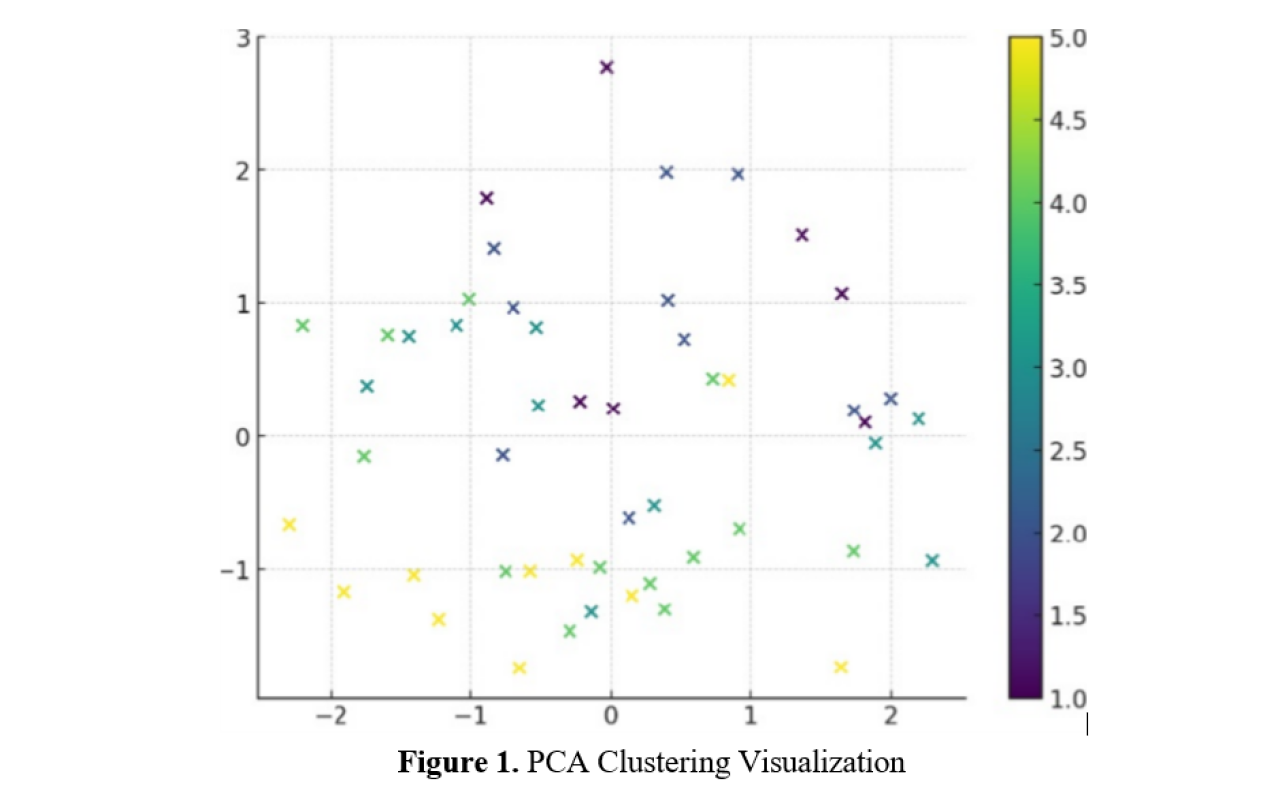
Many university students experience difficulties connecting graphical, symbolic, and analytical representations when solving extended-angle trigonometric problems, resulting in fragmented conceptual understanding. Previous studies have mainly examined misconceptions or instructional media separately, while limited research has explored how students transition between multiple mathematical representations. This study employed an explanatory sequential mixed-methods approach integrating quantitative and qualitative analyses to investigate students’ representational thinking patterns in extended-angle trigonometry learning. Students’ mean scores increased significantly from 54.30 to 75.80 (t = -8.92, p < 0.001), indicating substantial improvement in conceptual understanding after the instructional intervention. The findings revealed diverse thinking patterns, with most students relying on visual representations, while others preferred symbolic procedures. Students demonstrating analytical flexibility showed deeper representational coordination and conceptual comprehension, enabling smoother transitions among visualization, symbolic manipulation, and analytical reasoning. Principal Component Analysis (PCA) was employed for dimensionality reduction and visualization of students’ cognitive tendencies, while thematic analysis of interviews and think-aloud protocols provided deeper insights into students’ problem-solving processes. The study contributes a cognitive-transition framework explaining how students coordinate visualization, symbolic manipulation, and analytical reasoning in trigonometric problem solving and provides implications for designing adaptive instructional strategies that support representational flexibility and conceptual understanding.
References
Alajmi, A. H., & Al-Kandari, M. M. (2022). Calculus 1 college students’ concept of function. International Journal of Mathematical Education in Science and Technology, 53(2), 251–268. https://doi.org/10.1080/0020739X.2020.1798526
Aylward, R. C., & Cronjé, J. C. (2022). Paradigms extended: how to integrate behaviorism, constructivism, knowledge domain, and learner mastery in instructional design. Educational Technology Research and Development, 70(2), 503–529. https://doi.org/10.1007/S11423-022-10089-w
Begg, M., & Pierce, R. (2021). Symbols: the challenge of subscripts. International Journal of Mathematical Education in Science and Technology, 52(5), 787–794. https://doi.org/10.1080/0020739X.2020.1794071
Brieger, E., Arghode, V., & McLean, G. (2020). Connecting theory and practice: Reviewing six learning theories to inform online instruction. European Journal of Training and Development, 44(4–5), 321–339. https://doi.org/10.1108/EJTD-07-2019-0116
Byrd, N., Joseph, B., Gongora, G., & Sirota, M. (2023). Tell us what you really think: A think aloud protocol analysis of the verbal cognitive reflection test. Journal of Intelligence, 11(4), 76. https://doi.org/10.3390/jintelligence11040076
Castro-Alonso, J. C., de Koning, B. B., Fiorella, L., & Paas, F. (2021). Five strategies for optimizing instructional materials: Instructor- and learner-managed cognitive load. Educational Psychology Review, 33(4), 1379–1407. https://doi.org/10.1007/s10648-021-09606-9
Çekmez, E. (2020). What generalizations do students achieve with respect to trigonometric functions in the transition from angles in degrees to real numbers? The Journal of Mathematical Behavior, 58, 100778. https://doi.org/10.1016/j.jmathb.2020.100778
Dawadi, S., Shrestha, S., & Giri, R. A. (2021). Mixed-Methods Research: A Discussion on its Types, Challenges, and Criticisms. Journal of Practical Studies in Education , 2(2), 25–36. https://doi.org/10.46809/jpse.v2i2.20
Goldin, G. A. (2020). Mathematical representations. In Encyclopedia of mathematics education (pp. 566–572). https://doi.org/10.1007/978-3-030-15789-0_103
Greenacre, M., Groenen, P. J. F., Hastie, T., D’Enza, A. I., Markos, A., & Tuzhilina, E. (2022). Principal component analysis. Nature Reviews Methods Primers, 2(1), 1–21. https://doi.org/10.1038/s43586-022-00184-w
Hamzah, N., Maat, S. M., & Ikhsan, Z. (2021). A systematic review on pupils’ misconceptions and errors in trigonometry. Pegem Journal of Education and Instruction, 11(4), 209–218. https://doi.org/10.47750/pegegog.11.04.20
Knapp, T. R. (2016). Why Is the One-Group Pretest–Posttest Design Still Used? Clinical Nursing Research, 25(5), 467–472. https://doi.org/10.1177/1054773816666280
Kondratieva, M. (2021). Trusting Your Own Eyes: Visual Constructions, Proofs, and Fallacies in Mathematics. Handbook of Cognitive Mathematics, 1–37. https://doi.org/10.1007/978- 3-030-44982-7_38-1
Kurita, T. (2021). Principal Component Analysis (PCA). Computer Vision, 1013–1016. https://doi.org/10.1007/978-3-030-63416-2_649
Lee, J. E., Chan, J. Y. C., Botelho, A., & Ottmar, E. (2022). Does slow and steady win the race? Clustering patterns of students’ behaviors in an interactive online mathematics game. Educational Technology Research and Development, 70(5), 1575–1599. https://doi.org/10.1007/s11423-022-10138-4
Lepore, M. (2024). A holistic framework to model student’s cognitive process in mathematics education through fuzzy cognitive maps. Heliyon, 10(16), e35863. https://doi.org/10.1016/j.heliyon.2024.e35863
Li, X., Wu, Y., Wei, M., Guo, Y., Yu, Z., Wang, H., Li, Z., & Fan, H. (2021). A novel index of functional connectivity: phase lag based on Wilcoxon signed rank test. Cognitive Neurodynamics, 15(4), 621–636. https://doi.org/10.1007/S11571-020-09646-x
Marsden, E., & Torgerson, C. J. (2012). Single group, pre- and post-test research designs: Some methodological concerns. Oxford Review of Education, 38(5), 583–616. https://doi.org/10.1080/03054985.2012.731208
Mkhwanazi, T., Bansilal, S., & Brijlall, D. (2023). High School Mathematics Teachers’ Knowledge of Trigonometry and Geometry. Journal of Educational Studies, 22(2), 75–97. https://doi.org/10.59915/jes.2023.22.2.5
Nordlander, M. C. (2022). Lifting the understanding of trigonometric limits from procedural towards conceptual. International Journal of Mathematical Education in Science and Technology, 53(11), 2973–2986. https://doi.org/10.1080/0020739X.2021.1927226
Oktaviyanthi, R., & Sholahudin, U. (2023). Phet Assisted Trigonometric Worksheet for Students’ Trigonometric Adaptive Thinking. Mosharafa: Jurnal Pendidikan Matematika, 12(2), 229-242. https://doi.org/10.31980/mosharafa.v12i2.779
Orhani, S. (2024). Addressing Students’ Challenges in Acquiring Trigonometric Function Concepts: A Didactic Approach to Education for Sustainable Development. Journal of Education for Sustainable Development Studies, 1(2), 160–172. https://doi.org/10.70232/jesds.V1I2.15
Ramírez-Uclés, R., & Ruiz-Hidalgo, J. F. (2022). Reasoning, representing, and generalizing in geometric proof problems among 8th grade talented students. Mathematics, 10(5), 789. https://doi.org/10.3390/math10050789
Sekgoma, A., & Salani, E. (2023). Analyzing common trigonometric errors among first-year primary school student teachers at the University of Botswana. European Journal of Education Studies, 10(12). https://doi.org/10.46827/ejes.v10i12.5128
Sholahudin, U., & Oktaviyanthi, R. (2023). The Trigonometric Adaptive Worksheet Performance in Optimizing Trigonometric Thinking of Prospective Mathematics Teacher: Single Subject Research. Jurnal Didaktik Matematika, 10(2), 250–265. https://doi.org/10.24815/jdm.V10I2.33216
Teófilo De Sousa, R., Régis, F., & Alves, V. (2022). Quadratic functions and PhET: An investigation from the perspective of the theory of figural concepts. Contemporary Mathematics and Science Education, 3(1), ep22010. https://doi.org/10.30935/conmaths/11929
Ünal, Z. E., Ala, A. M., Kartal, G., Özel, S., & Geary, D. C. (2023). Visual and symbolic representations as components of algebraic reasoning. Journal of Numerical Cognition, 9(2), 327–345. https://doi.org/10.5964/jnc.11151
Van Garderen, D., Scheuermann, A., Sadler, K., Hopkins, S., & Hirt, S. M. (2021). Preparing Pre-Service Teachers to Use Visual Representations as Strategy to Solve Mathematics Problems: What Did They Learn? Teacher Education and Special Education, 44(4), 319–339. https://doi.org/10.1177/0888406421996070
Vierra, A., Razzaq, A., & Andreadis, A. (2023). Continuous variable analyses: t-test, Mann–Whitney U, Wilcoxon sign rank. In Handbook for designing and conducting clinical and translational surgery (pp. 165–170). https://doi.org/10.1016/b978-0-323-90300-4.00045-8
Wipulanusat, W., Panuwatwanich, K., Stewart, R. A., & Sunkpho, J. (2020). Applying Mixed Methods Sequential Explanatory Design to Innovation Management. Lecture Notes in Mechanical Engineering, 485–495. https://doi.org/10.1007/978-981-15-1910-9_40
Wolcott, M. D., & Lobczowski, N. G. (2021). Using cognitive interviews and think-aloud protocols to understand thought processes. Currents in Pharmacy Teaching and Learning, 13(2), 181–188. https://doi.org/10.1016/j.cptl.2020.09.005
Zengin, Y. (2021). Construction of proof of the Fundamental Theorem of Calculus using dynamic mathematics software in the calculus classroom. Education and Information Technologies, 27(2), 2331–2366. https://doi.org/10.1007/S10639-021-10666-1
Zhou, X., & Zeng, J. (2022). Three-component mathematics for students. Infant and Child Development, 31(1), e2283. https://doi.org/10.1002/icd.2283
Downloads
Published
How to Cite
Issue
Section
License
Copyright (c) 2026 Usep Sholahudin, Rina Oktaviyanthi, Niswa Nagina Lutfiah, Refa Jamal Ramahi

This work is licensed under a Creative Commons Attribution-NonCommercial-ShareAlike 4.0 International License.
License and Copyright Agreement
In submitting the manuscript to the journal, the authors certify that:
- They are authorized by their co-authors to enter into these arrangements.
- The work described has not been formally published before, except in the form of an abstract or as part of a published lecture, review, thesis, or overlay journal. Please also carefully read Journal of Honai Math Posting Your Article Policy at http://journalfkipunipa.org/index.php/jhm/about
- That it is not under consideration for publication elsewhere,
- That its publication has been approved by all the author(s) and by the responsible authorities – tacitly or explicitly – of the institutes where the work has been carried out.
- They secure the right to reproduce any material that has already been published or copyrighted elsewhere.
- They agree to the following license and copyright agreement.
Copyright
Authors who publish with Journal of Honai Math agree to the following terms:
- Authors retain copyright and grant the journal right of first publication with the work simultaneously licensed under a Creative Commons Attribution License (CC BY-NC-SA 4.0) that allows others to share the work with an acknowledgment of the work's authorship and initial publication in this journal.
- Authors are able to enter into separate, additional contractual arrangements for the non-exclusive distribution of the journal's published version of the work (e.g., post it to an institutional repository or publish it in a book), with an acknowledgment of its initial publication in this journal.
- Authors are permitted and encouraged to post their work online (e.g., in institutional repositories or on their website) prior to and during the submission process, as it can lead to productive exchanges, as well as earlier and greater citation of published work.