Integrating popular digital contexts into Realistic Mathematics Education: Designing a hypothetical learning trajectory for arithmetic sequences and series
DOI:
https://doi.org/10.30862/jhm.v8i3.1038Keywords:
Arithmetic sequences and series, Hypothetical learning trajectories, Popular contexts, Realistic mathematics education, Rigital classrooms, TikTokAbstract
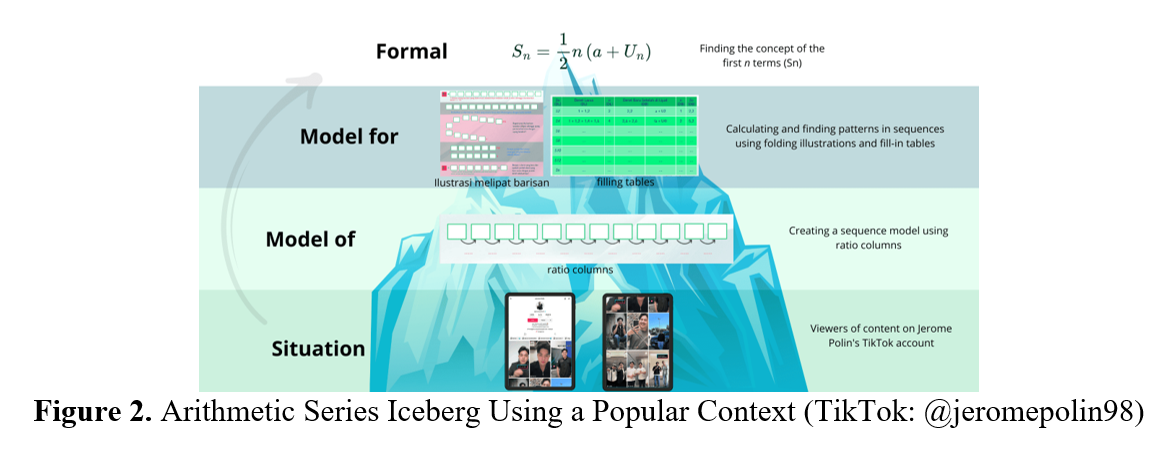
The integration of popular culture and digital platforms into mathematics learning remains underexplored, limiting the development of meaningful and context-based instructional designs. This study develops a Hypothetical Learning Trajectory (HLT) for arithmetic sequences and series by integrating TikTok into a digital mathematics classroom. The study was conducted within the preliminary design phase of design research using qualitative methods, including literature review, classroom observations, teacher interviews, and expert validation through focus group discussions. The resulting HLT consists of two iceberg models grounded in the principles of Realistic Mathematics Education (RME). Each model contains six sequential activities comprising one contextual situation and five guided mathematical problems. The first model employs viewer-growth data from the TikTok account @raimlaode94 to support students in constructing the arithmetic sequence formula (Un) through repeated addition and ratio tables. The second model uses engagement data from the TikTok account @jeromepolin98 to guide students in deriving the arithmetic series formula (Sn) using structured tables, ratio columns, and visual folding strategies. Both trajectories are collaboratively implemented using Canva to maximize the pedagogical use of digital devices. This study provides a theoretically grounded and scalable framework that connects students’ informal digital experiences with formal mathematical reasoning in technology-enhanced classrooms.
References
Andzin, N. S., Sari, P. Y. P., Widodo, R. C., Sukowati, D. I., Indriastuti, S., & Nursyahidah, F. (2024). Arithmetic sequences and series learning using realistic mathematics education assisted by augmented reality. Mathematics Education Journal, 18(1), 139–148. https://doi.org/10.22342/jpm.v18i1.pp139-148
CAN, D. (2020). Supporting learning trajectories for the development of number concept: Digital games. Kuramsal Eğitimbilim, 13(4), 663–684. https://doi.org/10.30831/akukeg.692165
Cirneanu, A. L., & Moldoveanu, C. E. (2024). Use of digital technology in integrated mathematics education. Applied System Innovation, 7(4). https://doi.org/10.3390/asi7040066
Clements, D. H., & Sarama, J. (2025). Systematic review of learning trajectories in early mathematics. ZDM - Mathematics Education, 57(4), 637–650. https://doi.org/10.1007/s11858-024-01644-1
Cuhanazriansyah, M. R., Anggraeni, R. D., & Irhadtanto, B. (2025). Sinergi antara fenomena “tiktok brain” dalam pembelajaran matematika di sekolah menengah pertama. Polinomial : Jurnal Pendidikan Matematika, 4(3), 570–579.
De Leyn, T., De Wolf, R., Vanden Abeele, M., & De Marez, L. (2022). In-between child’s play and teenage pop culture: tweens, TikTok & privacy. Journal of Youth Studies, 25(8), 1108–1125. https://doi.org/10.1080/13676261.2021.1939286
Domu, I., & Mangelep, N. O. (2020). The development of students’ learning material on arithmatic sequence using PMRI approach. Atlantis Press. https://doi.org/10.2991/aer.k.201124.076
Ferreira, S. M., & Bisognin, V. (2020). Construction of mathematical and financial concepts based on realistic mathematics education. Acta Scientiae, 22(5), 226–253. https://doi.org/10.17648/acta.scientiae.5925
Fifiana, Q., Bernard, M., & Yuliani, A. (2024). The Development of Problem Based Learning Canva-Assisted Teaching Materials to Improve Mathematical Probem Solving Ability on Integer. (JIML) Journal of Innovative Mathematics Learning, 7(2), 195-205.
Gravemeijer, K., & Cobb, P. (2006). Design research from a learning design perspective. In Educational Design Research (pp. 17–51). Taylor and Francis. https://doi.org/10.4324/9780203088364-12
Hasan, N. F., & Prabawanto, S. (2023). Learning Obstacles Siswa SMK Dalam Menyelesaikan Masalah Barisan Geometri. Jurnal Review Pendidikan Dan Pengajaran, 6(4), 1–7.
Hudayanti, D. V. F. T. (2022). Pemanfaatan canva sebagai modul digital interaktif matematika untuk mengoptimalkan pembelajaran jarak jauh. Jurnal Ilmiah Multi Disiplin Indonesia, 2(1), 163–173. https://katadata.co.id/berita/2020/01/06/baru-83-peserta-bpjs-kesehatan-per-akhir-2019-
Indriani, H., Putri, R. I. I., & Darmawijoyo, D. (2018). Learning design of sequence and series of arithmetic using the context of songket Palembang. In Sriwijaya University Learning and Education International Conference (pp. 451–457). Sriwijaya University. https://conference.unsri.ac.id/index.php/sule/article/view/1455
Kusumawardhani, E., & Sari, D. S. (2021). Gelombang pop culture Tik-Tok: Studi kasus Amerika Serikat, Jepang, India dan Indonesia. Padjadjaran Journal of International Relations, 3(1), 19. https://doi.org/10.24198/padjir.v3i1.27758
Lerman, S. (Ed.). (2020). Encyclopedia of mathematics education. Cham: Springer International Publishing.
Lestari, T. V. D., & Marsigit. (2020). Hypothetical learning trajectory and students’ understanding of the concepts of the arithmetic sequence. In Journal of Physics: Conference Series (Vol. 1581). Institute of Physics Publishing. https://doi.org/10.1088/1742-6596/1581/1/012038
Magbago, C., Rayon, S., & Godinez, C. (2025). Improving Students’ Achievement in Mathematics using Micro-learning Approach through TikTok Videos. European Journal of Education and Pedagogy, 6(3), 17–21. https://doi.org/10.24018/ejedu.2025.6.3.927
Marzuki, M., Teguh Ardianto, Rahadi Wirawan, I Wayan Sudiarta, Ramadian Ridho Illahi, Gusti Ayu Niatri, & Kormil Saputra. (2024). Pembimbingan penyelesaian soal tes pengetahuan kuantitatif dan tes penalaran matematika bagi siswa kelas XII SMAN 2 Selong Lombok Timur. Jurnal Pengabdian Inovasi Masyarakat Indonesia, 3(2), 100–107. https://doi.org/10.29303/jpimi.v3i2.5914
Mazlan, C. A. N., Abdullah, M. H., Sulong, M. A., Abas, A., Ramdan, M. R., Safian, A. R., & Fuad, D. R. S. M. (2023). Exploring the integration of bite-sized learning: A scoping review of research in education and related disciplines. Contemporary Educational Technology. Bastas. https://doi.org/10.30935/cedtech/13622
P., J., & J., A. (2022). Perceived Popularity of TikTok among Gen-Z. Cardiometry, (24), 896–902. https://doi.org/10.18137/cardiometry.2022.24.896902
Prado, M. E. B. B., da Costa, N. M. L., & Valente, J. A. (2023). A trajectory of digital technologies integration in mathematical education in Brazil: Challenges and opportunities (pp. 361–379). https://doi.org/10.1007/978-3-031-29900-1_15
Purnamasari, I., Siringoringo, M., Wahyuningsih, S., Hayati, M. N., Suyitno, S., Goejantoro, R., & Prangga, S. (2023). Pelatihan penggunaan fungsi hitung dasar dan logika matematika statistika untuk penyelesaian TIU. Jurnal Kreativitas Pengabdian Kepada Masyarakat (PKM), 6(1), 363–370. https://doi.org/10.33024/jkpm.v6i1.8423
Puspitasari, A. C. D. D. (2021). Aplikasi Tiktok sebagai media pembelajaran jarak jauh pada mahasiswa Universitas Indraprasta PGRI. Jurnal Educatio FKIP UNMA, 7(3), 1127–1134. https://doi.org/10.31949/educatio.v7i3.1317
Rawani, D., Wartini, W., & Delia Septimiranti. (2024). Local instruction theory pendidikan matematika realistik untuk sekolah menengah pertama menggunakan konteks tarian Sumatera Selatan. Indiktika : Jurnal Inovasi Pendidikan Matematika, 7(1), 160–172. https://doi.org/10.31851/indiktika.v7i1.16733
Risdiyanti, I., & Indra Prahmana, R. C. (2020). The learning trajectory of number pattern learning using barathayudha war stories and uno stacko. Journal on Mathematics Education, 11(1), 157–166. https://doi.org/10.22342/jme.11.1.10225.157-166
Riswanda, K. S. S., & Rakhmawati, I. A. (2025). A qualitative approach to Canva as a mathematics learning medium and its implementation in undergraduate students. Primatika: Jurnal Pendidikan Matematika, 14(1), 207-218.
Spooner, K., Nomani, J., & Cook, S. (2024). Improving high school students’ perceptions of mathematics through a mathematical modelling course. Teaching Mathematics and Its Applications, 43(1), 38–50. https://doi.org/10.1093/teamat/hrad001
Storey, J. (2021). Cultural theory and popular culture: An Introduction. Taylor and Francis. https://doi.org/10.4324/9781003011729
Sztajn, P., Confrey, J., Wilson, P. H., & Edgington, C. (2012). Learning trajectory based instruction: Toward a theory of teaching. Educational Researcher, 41(5), 147–156. https://doi.org/10.3102/0013189X12442801
Umasugi, S. M., Sugiman, S., Jana, P., & Kraiviset, P. (2022). Realistic Mathematics Education (RME)-based learning trajectory for arithmetic social using culinary context of Yogyakarta. Jurnal Kependidikan: Jurnal Hasil Penelitian Dan Kajian Kepustakaan Di Bidang Pendidikan, Pengajaran Dan Pembelajaran, 8(4), 985. https://doi.org/10.33394/jk.v8i4.6176
Van den Heuvel-Panhuizen, M., & Drijvers, P. (2014). Realistic Mathematics Education. In S. Lerman (Ed.), Encyclopedia of Mathematics Education (pp. 521-525). Springer.
Verschaffel, L., Schukajlow, S., Star, J., & Van Dooren, W. (2020). Word problems in mathematics education: a survey. ZDM - Mathematics Education, 52(1), 1–16. https://doi.org/10.1007/s11858-020-01130-4
Vos, P. (2018, December 1). “How real people really need mathematics in the real world”—authenticity in mathematics education. Education Sciences. MDPI AG. https://doi.org/10.3390/educsci8040195
Wangsa, A., Marniati, M., & Umasugi, S. M. (2024). Eksplorasi rumah adat mekongga sebagai konteks pembelajaran matematika. PYTHAGORAS Jurnal Pendidikan Matematika, 19(2), 126–138. https://doi.org/10.21831/pythagoras.v19i2.77937
Webb, D. C. (2017). The iceberg model: Rethinking mathematics instruction from a student perspective. Annual Perspectives in Mathematics Education: Reflective and Collaborative Processes to Improve Mathematics Teaching, 201–209.
Wulandari, D. U., Mariana, N., Wiryanto, W., & Amien, M. S. (2024). Integration of ethnomathematics teaching materials in mathematics learning in elementary school. IJORER : International Journal of Recent Educational Research, 5(1), 204–218. https://doi.org/10.46245/ijorer.v5i1.542
Wulandari, M., & Setiawan, W. (2021). Analisis kesulitan dalam menyelesaikan soal materi barisan pada siswa SMA. Jurnal Pembelajaran Matematika Inovatif, 4(3), 571–578.
Yee, S. P., & Bostic, J. D. (2014). Developing a contextualization of students’ mathematical problem solving. Journal of Mathematical Behavior, 36, 1–19. https://doi.org/10.1016/j.jmathb.2014.08.002
Downloads
Published
How to Cite
Issue
Section
License
Copyright (c) 2026 Arma Wangsa, Deti Sri Rahayu, Putri Wahdaniah, Sitti Mutia Umasugi

This work is licensed under a Creative Commons Attribution-NonCommercial-ShareAlike 4.0 International License.
License and Copyright Agreement
In submitting the manuscript to the journal, the authors certify that:
- They are authorized by their co-authors to enter into these arrangements.
- The work described has not been formally published before, except in the form of an abstract or as part of a published lecture, review, thesis, or overlay journal. Please also carefully read Journal of Honai Math Posting Your Article Policy at http://journalfkipunipa.org/index.php/jhm/about
- That it is not under consideration for publication elsewhere,
- That its publication has been approved by all the author(s) and by the responsible authorities – tacitly or explicitly – of the institutes where the work has been carried out.
- They secure the right to reproduce any material that has already been published or copyrighted elsewhere.
- They agree to the following license and copyright agreement.
Copyright
Authors who publish with Journal of Honai Math agree to the following terms:
- Authors retain copyright and grant the journal right of first publication with the work simultaneously licensed under a Creative Commons Attribution License (CC BY-NC-SA 4.0) that allows others to share the work with an acknowledgment of the work's authorship and initial publication in this journal.
- Authors are able to enter into separate, additional contractual arrangements for the non-exclusive distribution of the journal's published version of the work (e.g., post it to an institutional repository or publish it in a book), with an acknowledgment of its initial publication in this journal.
- Authors are permitted and encouraged to post their work online (e.g., in institutional repositories or on their website) prior to and during the submission process, as it can lead to productive exchanges, as well as earlier and greater citation of published work.