
Designing Mode Learning based PMRI-STEM Approach using the Coffee Grinder Context for Culinary Arts Vocational High School Students
DOI:
https://doi.org/10.30862/jhm.v9i2.1289Keywords:
coffee grinder, culinary arts vocational high school, mode learning, mathematical literacy, PMRI-STEM approachAbstract
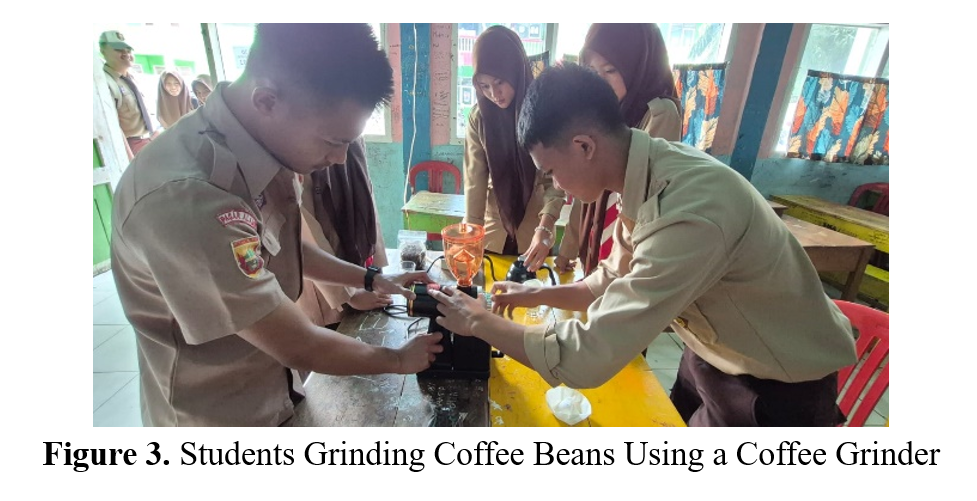
Learning mode as one of the measures of central tendency is often limited to identifying the value that appears most frequently without understanding its meaning in real-world situations. Students tend to understand mode procedurally but experience difficulties in interpreting it as a representation of majority preference in contextual decision-making. Therefore, this study aims to design mode learning based on the PMRI-STEM approach using the context of coffee grinder use to support students’ conceptual understanding of mode in Culinary Arts Vocational High School. This study employed a design research approach consisting of preliminary design, teaching experiment, and retrospective analysis. The participants were 25 students in Grade 10 Culinary Arts Vocational High School. Data were collected through classroom observations, students’ worksheets, interviews, and learning documentation, then analyzed descriptively to examine students’ learning processes during PMRI-STEM learning activities. The study resulted in a learning trajectory consisting of activities involving adjusting grinder machine settings, grinding coffee beans with different grind sizes, observing brewing characteristics, organizing preference data into frequency tables, and determining the mode as the most frequently chosen grind size. The findings showed that students were able to identify the mode correctly and interpret it as a representation of majority customer preference used for determining standard coffee shop menu settings. Students also developed contextual reasoning by connecting grinder settings, brewing results, data representation, and statistical decision-making. These findings indicate that PMRI-STEM learning using the context of coffee grinders can support students’ understanding of mode and contextual statistical literacy in vocational mathematics learning.
References
Armiati, Fauzan, A., Harisman, Y., & Sya’Bani, F. (2022). Local instructional theory of probability topics based on realistic mathematics education for eight-grade students. Journal on Mathematics Education, 13(4), 703–722. https://doi.org/10.22342/jme.v13i4.pp703-722
Bakker, A. (2018). Design research in education: A practical guide for early career researchers. Taylor & Francis. https://doi.org/10.4324/9780203701010
Cazorla, I. M., Utsumi, M. C., & Magina, S. M. (2023). The conceptual field of measures of central tendency: A first approximation. International Electronic Journal of Mathematics Education, 18(4), em0748. https://doi.org/10.29333/iejme/13571
Creswell, J. W., & Creswell, J. D. (2018). Research design: Qualitative, quantitative, and mixed methods approaches (5th ed.). SAGE Publications.
Dierdorp, A., Bakker, A., van Maanen, J. A., & Eijkelhof, H. M. (2014). Meaningful statistics in professional practices as a bridge between mathematics and science: An evaluation of a design research project. International Journal of STEM Education, 1(1). https://doi.org/10.1186/s40594-014-0009-1
Fauzan, A., Musdi, E., & Afriadi, J. (2018). Developing learning trajectory for teaching statistics at junior high school using RME approach. Journal of Physics: Conference Series, 1088, 1–8. https://doi.org/10.1088/1742-6596/1088/1/012040
Fisher, D., Kusumah, Y. S., & Dahlan, J. A. (2020). Project-based learning in mathematics: A literature review. Journal of Physics: Conference Series, 1657(1), 1–8. https://doi.org/10.1088/1742-6596/1657/1/012032
Flores-Fuentes, G., & Juárez-Ruiz, E. de L. (2017). Aprendizaje basado en proyectos para el desarrollo de competencias matemáticas en bachillerato. Revista Electrónica de Investigación Educativa, 19(3), 71–91. https://doi.org/10.24320/redie.2017.19.3.721
Geitz, G., & de Geus, J. (2019). Design-based education, sustainable teaching, and learning. Cogent Education, 6(1). https://doi.org/10.1080/2331186X.2019.1647919
Genc, M., & Erbas, A. K. (2019). Secondary mathematics teachers’ conceptions of mathematical literacy. International Journal of Education in Mathematics, Science and Technology, 7(3), 222–237. https://ijemst.net/index.php/ijemst/article/view/611/179
Gravemeijer, K., & Cobb, P. (2006). Design research from a learning design perspective. In J. van den Akker, K. Gravemeijer, S. McKenney, & N. Nieeven (Eds.), Educational design research (pp. 29–63). Routledge. https://doi.org/10.4324/9780203088364
Gravemeijer, K., & Cobb, P. (2013). Design research from the learning design perspective. In Educational design research part A: An introduction. Netherlands Institute for Curriculum Development (SLO).
Gustiningsi, T., Putri, R. I. I., Zulkardi, & Hapizah. (2023). LEPscO: Mathematical literacy learning environment for the Guru Penggerak program. Journal on Mathematics Education, 15(2), 661–682. http://doi.org/10.22342/jme.v15i2.pp661-682
Ismail, Z., & Chan, S. W. (2015). Malaysian students’ misconceptions about measures of central tendency: An error analysis. AIP Conference Proceedings, 1643, 93–100. https://doi.org/10.1063/1.4907430
Koparan, T. (2015). Difficulties in learning and teaching statistics: Teacher views. International Journal of Mathematical Education in Science and Technology, 46(1), 94–104. https://doi.org/10.1080/0020739X.2014.941425
Landtblom, K. (2023). Opportunities to learn mean, median, and mode afforded by textbook tasks. Statistics Education Research Journal, 22(3), 1–17. https://doi.org/10.52041/SERJ.V22I3.655
Meitrilova, A., & Putri, R. I. I. (2020). Learning design using PMRI to teach central tendency materials. Journal of Physics: Conference Series, 1470(1), 1–11. https://doi.org/10.1088/1742-6596/1470/1/012086
Nursyahidah, F., Albab, I. U., & Rubowo, M. R. (2025a). Designing learning trajectory on data distribution measurement through PMRI. Mathematics Education Journal, 19(3), 527–546. https://doi.org/10.22342/mej.v19i3.pp527-546
Nursyahidah, F., Wardono, W., Mariani, S., & Wijayanti, K. (2025b). Integrating technology, ethnomathematics, and realistic mathematics education in learning statistics: A learning trajectory. Infinity Journal, 14(3), 633–654. https://doi.org/10.22460/infinity.v14i3.p633-654
Organisation for Economic Co-operation and Development. (2023). PISA 2022 results (Volume I): The state of learning and equity in education. OECD Publishing. https://doi.org/10.1787/53f23881-en
Parra-Fica, J. H., del Mar López-Martín, M., & Díaz-Levicoy, D. (2024). Measures of central tendency in primary education textbooks in Chile. Eurasia Journal of Mathematics, Science and Technology Education, 20(6). https://doi.org/10.29333/EJMSTE/14592
Putri, R. I. I., & Zulkardi. (2020). Designing PISA-like mathematics task using Asian Games context. Journal on Mathematics Education, 11(1), 135–144. https://doi.org/10.22342/jme.11.1.9786.135-144
Rahayu, P. T., & Putri, R. I. I. (2021). The data package in learning mean using LSLC and PMRI. Mathematics Education Journal, 15(1), 61–70. https://doi.org/10.22342/jpm.15.1.9431.61-70
Rawani, D., Putri, R. I. I., Zulkardi, & Susanti, E. (2023). RME-based local instructional theory for translation and reflection using of South Sumatra dance context. Journal on Mathematics Education, 14(3), 545–562. https://doi.org/10.22342/jme.v14i3.pp545-562
Revina, S., & Leung, F. (2019). How the same flowers grow in different soils? The implementation of realistic mathematics education in Utrecht and Jakarta classrooms. International Journal of Science and Mathematics Education, 17, 565–589. https://doi.org/10.1007/s10763-018-9883-1
Risdiyanti, I., Zulkardi, Putri, R. I. I., & Prahmana, R. C. I. (2024). Mathematical literacy learning environment for inclusive education teachers: A framework. Journal on Mathematics Education, 15(3), 1003–1026. https://doi.org/10.22342/jme.v15i3.pp1003-1026
Saidi, S. S., & Siew, N. M. (2018). Assessing students’ understanding of the measures of central tendency and attitude towards statistics in rural secondary schools. International Electronic Journal of Mathematics Education, 14(1), 73–86. https://doi.org/10.12973/iejme/3968
Serin, H. (2023). The significance of mathematical literacy in today’s society. International Journal of Social Science & Educational Studies, 10(2), 396–402. https://doi.org/10.23918/ijsses.v10i2p396
Stacey, K. (2011). The PISA view of mathematical literacy in Indonesia. Journal on Mathematics Education, 2(2), 95–126. https://doi.org/10.22342/jme.2.2.746.95-126
Stacey, K. (2014). Assessing mathematical literacy: The PISA experience. Springer International Publishing. https://doi.org/10.1007/978-3-319-10121-7
Wijaya, T. T., Hidayat, W., Hermita, N., Alin, J. A., & Talib, C. A. (2024). Exploring contributing factors to PISA 2022 mathematics achievement: Insights from Indonesian teachers. Infinity Journal, 13(1), 139–156. https://doi.org/10.22460/infinity.v13i1.p139-156
Zhang, Y. (2018). Application of project teaching method on statistical analysis teaching. In 6th International Conference on Social Science, Education and Humanities Research (SSEHR 2017) (pp. 253–256).
Zulkardi, Meryansumayeka, Putri, R. I. I., Alwi, Z., Nusantara, D. S., Ambarita, S. M., Maharani, Y., & Puspitasari, L. (2020a). How students work with PISA-like mathematical tasks using Covid-19 context. Journal on Mathematics Education, 11(3), 405–416. https://doi.org/10.22342/jme.11.3.12915.405-416
Zulkardi, Putri, R. I. I., & Wijaya, A. (2020b). Two decades of realistic mathematics education in Indonesia. In International reflections on the Netherlands didactics of mathematics (pp. 325–340). https://doi.org/10.1007/978-3-030-20223-1_18
Zulkardi, & Kohar, A. W. (2018). Designing PISA-like mathematics tasks in Indonesia: Experiences and challenges. Journal of Physics: Conference Series, 957(1), 012015. https://doi.org/10.1088/1742-6596/947/1/012015
Zulkardi, & Putri, R. I. I. (2019). New school mathematics curricula, PISA and PMRI in Indonesia. In C. P. Vistro-Yu & T. L. Toh (Eds.), School mathematics curricula: Asian perspectives and glimpses of reform (pp. 39–49). Springer Singapore. https://doi.org/10.1007/978-981-13-6312-2_3
Downloads
Published
How to Cite
Issue
Section
License
Copyright (c) 2026 Novi Susanti, Ratu Ilma Indra Putri, Nyimas Aisyah, Hartono Hartono

This work is licensed under a Creative Commons Attribution-NonCommercial-ShareAlike 4.0 International License.
License and Copyright Agreement
In submitting the manuscript to the journal, the authors certify that:
- They are authorized by their co-authors to enter into these arrangements.
- The work described has not been formally published before, except in the form of an abstract or as part of a published lecture, review, thesis, or overlay journal. Please also carefully read Journal of Honai Math Posting Your Article Policy at http://journalfkipunipa.org/index.php/jhm/about
- That it is not under consideration for publication elsewhere,
- That its publication has been approved by all the author(s) and by the responsible authorities – tacitly or explicitly – of the institutes where the work has been carried out.
- They secure the right to reproduce any material that has already been published or copyrighted elsewhere.
- They agree to the following license and copyright agreement.
Copyright
Authors who publish with Journal of Honai Math agree to the following terms:
- Authors retain copyright and grant the journal right of first publication with the work simultaneously licensed under a Creative Commons Attribution License (CC BY-NC-SA 4.0) that allows others to share the work with an acknowledgment of the work's authorship and initial publication in this journal.
- Authors are able to enter into separate, additional contractual arrangements for the non-exclusive distribution of the journal's published version of the work (e.g., post it to an institutional repository or publish it in a book), with an acknowledgment of its initial publication in this journal.
- Authors are permitted and encouraged to post their work online (e.g., in institutional repositories or on their website) prior to and during the submission process, as it can lead to productive exchanges, as well as earlier and greater citation of published work.




