From enrollees to exit: Exploring factors associated with attrition in mathematics teacher education
DOI:
https://doi.org/10.30862/jhm.v9i2.1273Keywords:
Exploratory factor analysis (EFA), Higher education institutions (HEIs), Mathematics teacher education, Students’ attritionAbstract
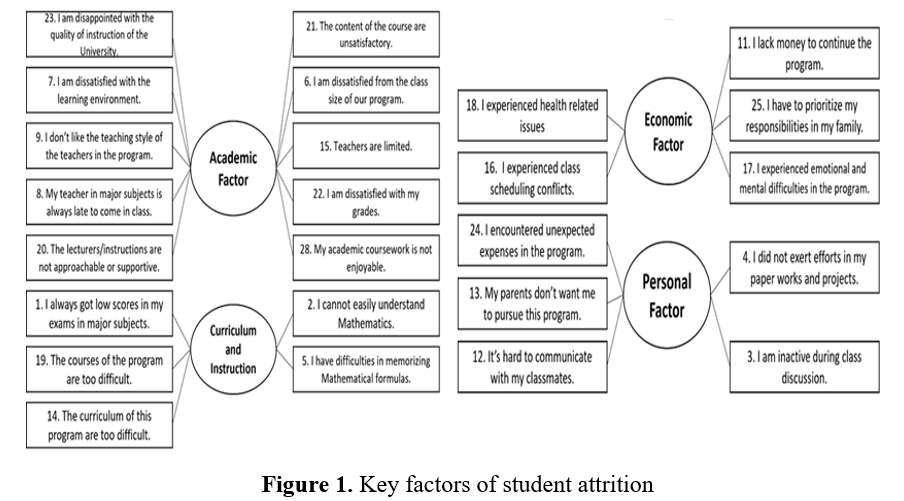
This study aimed to identify the key factors associated with student attrition in the Bachelor of Secondary Education major in Mathematics (BSED Mathematics) program. Data were collected through an online Likert-scale questionnaire administered to 201 participants from BSED Mathematics programs across different higher education institutions (HEIs) in the Philippines. The participants included graduates, students who shifted to other programs, and students who discontinued their studies. Convenience sampling was used to recruit participants. Exploratory factor analysis (EFA) was conducted to identify the underlying dimensions associated with student attrition. The analysis revealed four factors: academic factors, curriculum and instruction, economic factors, and personal factors. Together, these factors explained 54.27% of the total variance, with factor loadings ranging from 0.413 to 0.783. The findings indicate that student attrition in BSED Mathematics is associated with multiple and interrelated factors involving academic experiences, curriculum and instruction, economic conditions, and personal circumstances. These findings provide a basis for understanding the factors that may contribute to students’ decisions to remain in, shift from, or discontinue a mathematics teacher education program and may inform the development and evaluation of appropriate student-retention strategies in mathematics teacher education.
References
Alcauter, I., Martinez-Villaseñor, L., & Ponce, H. (2023). Explaining factors of student attrition at higher education. Computación y Sistemas, 27(4), 929–940. https://doi.org/10.13053/cys-27-4-4776
Bernardino, J. I., Fernandez, A., Molera, W., Mensenares, M. M., & Simbulan, M. C. (2024). Understanding students’ attrition behavior in a Philippine private higher education institution: Basis for an intervention plan. iCONNECT Multidisciplinary Research Journal, 1(2), 23-35. https://ejournals.ph/article.php?id=23190
Bravo, E. D. (2023). Trends and causes of student dropouts in a public higher education in Northern Philippines: A data visualization approach. Journal for Educators, Teachers and Trainers, 14(3), 702–711. https://doi.org/10.47750/jett.2023.14.03.081
Conzatti, M. P. (2022). Tuition-free college and retention: A quantitative analysis of the New York State Excelsior Scholarship Program [Doctoral dissertation, St. John’s University]. St. John’s Scholar. https://scholar.stjohns.edu/theses_dissertations/422/
Detmer, A. (2022). Higher education global data report, working document. UNESCO. https://unesdoc.unesco.org/ark:/48223/pf0000389859
Donch, S. (2024). Teacher attrition: A quantitative analysis of driving factors and potential solutions among highly qualified K–12 U.S. public school teachers [Doctoral dissertation, Abilene Christian University]. Digital Commons @ ACU. https://digitalcommons.acu.edu/etd/788/
Edalatifard, H., Prieto, E., & Mahata, K. (2012). The impact of curriculum on engineering students’ attrition. In Proceedings of the 23rd Annual Conference of the Australasian Association for Engineering Education. Australasian Association for Engineering Education. https://aaee.net.au/wp-content/uploads/2018/10/AAEE2012-Edalatifard_Prieto_Mahata-Curriculum_impact_on_engineering_student_attrition.pdf
Ertem, H. Y., & Gokalp, G. (2022). Role of personal and organizational factors on student attrition from graduate education: Mixed-model research. Journal of College Student Retention: Research, Theory & Practice, 23(4), 903–928. https://doi.org/10.1177/1521025119881391
Karlberg, M., & Bezzina, C. (2022). The professional development needs of beginning and experienced teachers in four municipalities in Sweden. Professional Development in Education, 48(4), 624–641. https://doi.org/10.1080/19415257.2020.1712451
Lorenzo-Quiles, O., Galdón-López, S., & Lendínez-Turón, A. (2023). Factors contributing to university dropout: A review. Frontiers in Education, 8, 1159864. https://doi.org/10.3389/feduc.2023.1159864
Magen-Nagar, N., & Shachar, H. (2017). Quality of teaching and dropout risk: A multi-level analysis. Journal of Education for Students Placed at Risk, 22(1), 9–24. https://doi.org/10.1080/10824669.2016.1242069
McLeod, J. J. (2019). The effects on student retention by implementing contextualized, program-specific learning modules in an online student success course: A practice report. Student Success, 10(1), 141–146. https://doi.org/10.5204/ssj.v10i1.1095
Mintz, S. (2024). How to improve the quality of college teaching. Inside Higher Ed. https://www.insidehighered.com/opinion/blogs/higher-ed-gamma/2024/10/16/colleges-need-change-strategy-put-teaching-first
Olufemioladebinu, T., Adediran, A. A., & Oyediran, W. O. (2018). Factors influencing the academic achievement of students in Colleges of Education in Southwest, Nigeria. Journal of Education and Human Development, 7(3), 109–115. https://doi.org/10.15640/jehd.v7n3a12
Rai, H., & Penjor, S. (2020). The impact of remedial class on students’ learning achievement. Contemporary Education and Teaching Research, 1(2), 27–34. https://doi.org/10.47852/bonviewCETR2020010203
Sá, M. J. (2023). Student academic and social engagement in the life of the academy—A lever for retention and persistence in higher education. Education Sciences, 13(3), 269-283. https://doi.org/10.3390/educsci13030269
Selagea, M. (2024, August 27). Understanding and supporting stop out students. OneGoal. Retrieved from: https://www.onegoal.org/about/blog/understanding-and-supporting-stop-out-students/
Tandet, J. (2023). Student persistence vs. retention in higher education. Modern Campus. Retrieved from: https://moderncampus.com/blog/persistence-vs-retention.html
Watermark. (2023). The essential guide to student engagement. Retrieved from: https://www.watermarkinsights.com/learn/ebook/the-essential-guide-to-student-engagement-with-watermark-insights/
Downloads
Published
How to Cite
Issue
Section
License
Copyright (c) 2026 Princes Mira Calig, Vivien Buenaagua, Jaycel Magno, Aira Mae Salamanque, Jake Sanda, John Ben Temones

This work is licensed under a Creative Commons Attribution-NonCommercial-ShareAlike 4.0 International License.
License and Copyright Agreement
In submitting the manuscript to the journal, the authors certify that:
- They are authorized by their co-authors to enter into these arrangements.
- The work described has not been formally published before, except in the form of an abstract or as part of a published lecture, review, thesis, or overlay journal. Please also carefully read Journal of Honai Math Posting Your Article Policy at http://journalfkipunipa.org/index.php/jhm/about
- That it is not under consideration for publication elsewhere,
- That its publication has been approved by all the author(s) and by the responsible authorities – tacitly or explicitly – of the institutes where the work has been carried out.
- They secure the right to reproduce any material that has already been published or copyrighted elsewhere.
- They agree to the following license and copyright agreement.
Copyright
Authors who publish with Journal of Honai Math agree to the following terms:
- Authors retain copyright and grant the journal right of first publication with the work simultaneously licensed under a Creative Commons Attribution License (CC BY-NC-SA 4.0) that allows others to share the work with an acknowledgment of the work's authorship and initial publication in this journal.
- Authors are able to enter into separate, additional contractual arrangements for the non-exclusive distribution of the journal's published version of the work (e.g., post it to an institutional repository or publish it in a book), with an acknowledgment of its initial publication in this journal.
- Authors are permitted and encouraged to post their work online (e.g., in institutional repositories or on their website) prior to and during the submission process, as it can lead to productive exchanges, as well as earlier and greater citation of published work.