
Mathematical creativity in algebraic tasks of South African secondary school mathematics textbooks
DOI:
https://doi.org/10.30862/jhm.v9i1.1059Keywords:
Algebra, mathematical creativity, mathematical tasks, textbookAbstract
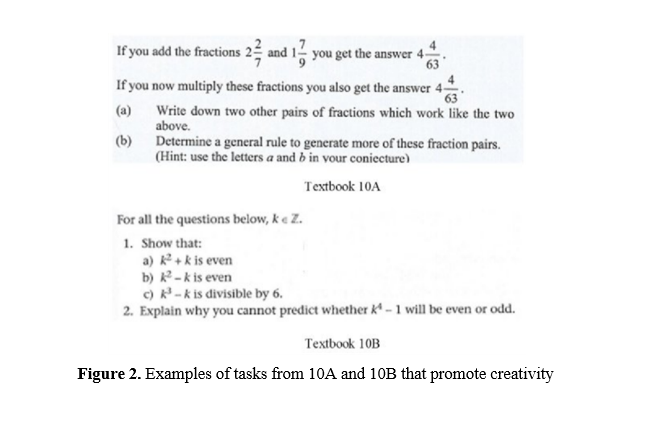
Fostering mathematical creativity is widely recognized as a fundamental objective of mathematics education because it enhances learners’ problem-solving capabilities and contributes to the achievement of Sustainable Development Goal 4 (Quality Education). However, limited empirical research has explored the extent to which mathematics textbooks support the development of mathematical creativity. This study examined how algebraic tasks in two South African secondary school mathematics textbook series promote mathematical creativity. Six textbooks were analyzed using quantitative content analysis, and independent samples t-tests were employed to determine whether significant differences existed between the textbook series. The analysis was guided by Ramelan and Wijaya’s framework of mathematical creativity, which comprises four dimensions: fluency, flexibility, elaboration, and originality. The findings revealed that the two textbook series fostered these dimensions to varying degrees. One series demonstrated a stronger emphasis on elaboration and originality, whereas the other provided greater support for fluency and flexibility. Overall, the textbooks moderately promoted fluency but offered limited opportunities for learners to develop flexibility, elaboration, and originality, suggesting that algebraic tasks generally provide insufficient support for the cultivation of mathematical creativity. Furthermore, the independent samples t-test indicated no statistically significant difference between the two textbook series in their overall promotion of mathematical creativity. These findings highlight a misalignment between curriculum aspirations and textbook implementation and underscore the need for richer, open-ended algebraic tasks that better support creative mathematical thinking.
References
Abdul Hamid, N. H., & Kamarudin, N. (2021). Assessing students’ mathematics achievement and mathematical creativity using mathematical creative approach: A quasi-experimental research. Asian journal of university education, 17 (2), 100-112. https://doi.org/10.24191/ajue.vg17i2.13399
Aktas, M. C. (2016). Turkish high school teachers’ conceptions of creativity in mathematics. Journal of education and training studies. 4(2), 42-52. https://doi.org/10.11114/jets.vg4i2.1123
AL-Rababaha, Y., Yew, W. T., & Meng, C. C. (2022). Algebra Misconceptions among Tenth Graders in the United Arab Emirates. International Journal of Academic Research in Progressive Education and Development, 11(1), 703–728. http://dx.doi.org/10.6007/IJARPED/v11-i1/12197
Bales, M. P., & Estomo, R. T. (2022). Mathematical creativity, mathematical self-efficacy, and mathematics problem-solving performance of high school students in different curricular programs. International journal of research publication and reviews, 3 (9), 286-294. https://doi.org/10.55248/gengpi.2022.3.9.6
Bicer, A. (2021). A systemic literature review: Discipline-specific and general instructional practices fostering the mathematical creativity of students. International journal of education in mathematics, science and technology, 9(2), 252-281. https://doi.org/10.46328/ijemst.1254
Bicer, A., Marquez, A., Colindres, K. V. M., Schanke, A. A., Castellon, L. B., Audette, L. M., Perihan, C., & Lee, Y. (2021). Investigating creativity -directed tasks in middle school mathematics curricula. Thinking skills, and creativity, 40. 100823. https://doi.org/10.1016/j.tsc.2021.100823
Chamberlin, S. A., & Moon, S. M. (2005). Model-eliciting activities as tools to develop and identify creativity gifted mathematicians. Journal of secondary gifted education, 17 (1), 37-47.
Chandler, K., Adu-Gyamfi, K., & Preston, R. (2023). Making Connections Explicit. Mathematics Teacher: Learning and Teaching PK-12, 116(8), 572–585. https://doi.org/10.5951/mtlt.2022.0345
Childs, P., Han, J., Chen, L., Jiang, P., Wang, P., Park, D., Yin, Y., Dieckmann, E., & Vilanova, I. (2022). The creativity diamond-A framework to aid creativity. Journal of intelligence. 10(4),73. https://doi.org/10.3390/jintelligence10040073
Czarnocha, B. (2014). On the culture of creativity in mathematics education. Teaching Innovations, 27 (3), 31-45. https://doi.org/10.5937/inovacije1403031c
Department of Basic Education. (2011). Curriculum and assessment policy statement: Grades 10–12. https://www.education.gov.za/curriculum/CurriculumAssessmentPolicyStatements(CSPS).aspx
DeVink, I. S., Willemsen, R. H., Lazonder, A. W., & Kroesbergen, F. H. (2022). Creativity in mathematics performance: The role of divergent and convergent thinking. British journal of educational psychology, 92, 484-501. https://doi.org/10.1111/bjep.12459
Gan, H. H. (2023). Evaluating the appropriateness of tasks and the elaboration of multiple solutions to occasion fourth graders’ mathematical creative thinking. Problems of education in the 21st century, 81(1), 44-65. https://doi.org/10.33225/pec/23.81.44
Hafizi, M. M. M., & Kamarudin, N. (2020). Creativity in mathematics: Malaysian perspective. Universal journal of educational research, 8 (3C): 77-84. https://doi.org/10.13189/ujer.2020.081609
Hernandez-Torrano, D., & Ibgrayevga, L. (2020). Creativity and education. A bibliometric mapping of the research literature (1975-2019). Thinking skills and creativity, 35, 100625. https://doi.org/10.1016/j.tsc.2019.100625
Huang, P., Peng, S., Chen, H., Tseng, L., & Hsu, L. (2017). The relative influences of domain knowledge and domain-general divergent thinking on scientific creativity. Thinking skills and creativity, 25, 1-9. https://doi.org/10.1016/j.tsc.2017.06.001
Joklitschke, J., Rott, B., Scghindler, M. (2022). Notions of creativity in mathematics education research: A systematic literature review. International journal of science and mathematics education, 20. 1161-1181. https://doi.org/10.1007/s10763-021-10192-z
Kaufman, J. C., & Beghetto, R. A. (2009). Beyond big and little: The four C model of creativity. Review of general psychology, 13 (1), 1-12. https://doi.org/10.1037/a0013688
Khalid, M., Saad, S., Abdul Hamid, S. R., Ridhuan Abdullah, M., Ibrahim, H., & Shahrill, M. (2020). Enhancing creativity and problem-solving skills through creative problem solving in teaching mathematics. Creativity studies, 13 (2), 270-291. https://doi.org/10.3846/cs.2020.11027
Klein, S., & Leikin, R. (2020). Openning mathematical problems for posing open mathematical tasks: What do teachers do and feel? Educational studies in mathematics, 105, 349-365
Levenson, E. (2013). Tasks that may occasion mathematical creativity: teachers’ choice. Mathematics teacher education. 16, 269-291. https://doi.org/10.1007/s10857-012-9229-9
Lu, X., & Kaiser, G. (2022). Can mathematical modelling work as a creativity-demanding activity? An empirical study in China. ZDM- Mathematics education, 54, 67-81. https://doi.org/10.1007/s11858-021-01316-4
Miranda, P., & Mamede, E. (2022). Appealing to creativity through solving and posing problems in mathematics class. Acta scientiae, 24 (4), 109-146. https://doi.org/10.17648/acgta.scientiae.7024
Munro, J. (2019). Creativity in education: What educators need to know. Education: Future frontiers. Accessed from education.nsw.gov.an
Nadjafikhah, M., Yaftian, N., & Bakhshalizadeh, S. (2012). Mathematical creativity: Some definitions and characteristics. Procedia-Social and behavioral sciences, 31, 285-291. https://doi.org/10.1016/j.sbspro.2011.12.056
OECD. (2019). PISA 2021 creative thinking framework (3rd draft). pp1-56
Owan, V. J., Ukam, C. U., & Egame, E. A. (2023). Beyond school grades: Measuring students’ learning outcomes and the emergence of achievers and underachievers. Journal of Pedagogical Sociology and Psychology, 5(3), 1-20. https://doi.org/10.33902/jpsp.202320925
Ramelan, M., & Wijaya, A. (2019). A comparative analysis of Indonesian and Singaporean mathematics textbooks from the perspective of mathematical creativity: A case of statistics and probability. Journal of Physics: Conference series 1320(2019),012037. https://doi.org/10.1088/1742-6596/1320/1/012037
Riling, M. (2020). Recognising mathematics students as creative: mathematical creativity as community-based and possibility-expanding. Journal of humanistic mathematics, 10 (2), 6-39. https://doi.org/10.5642/jhummath.202002.04
Schoevers, E. M., Kroesbergen, E. H., & Kattou, M. (2018). Mathematical creativity: A combination of domain general creative and domain specific mathematical skills. Journal of creative behaviour, 54 (2), 242-252. https://doi.org/10.1002/jocb.361
Scott-Barrett, J., Johnston, S., Denton-Calabrese, T., McGrane, J. A., & Hopfenbeck, T. N. (2023). Nurturing curiosity and creativity in primary school classrooms. Teaching and teacher education, 135, 1044356. https://doi.org/10.1016/j.tate.2023.104356
Sriraman, B. (2005). The characteristics of mathematical creativity. The mathematics educator, 14 (1), 19-34.
Tubb, A. L., Cropley, D. H., Marrone, R. L., Patston, T., & Kaufman, J. C. (2020). The development of mathematical creativity across high school: Increasing, decreasing, or both? Thinking skills and creativity, 35,100634. https://doi.org/10.1016/j.tsc.2020.100634
Ubah, I. J. A. & Ogbonnaya, U. I. (2021). Primary school pre-service teachers’ solutions to pattern problem-solving tasks based on three components of creativity. South African Journal of Education, 41(4), 1-10. https://doi.org/10.15700/saje.v41n4a1933
Yazgan-Sag, G., & Emre-Akdogan, E. (2016). Creativity from two perspectives: Prospective mathematics teachers and mathematicians. Australian journal of teacher education, 41(12),25-40. https://dx.doi.org/10.14221/ajte.2016gv41n12.3
Yerushalmy, M. (2009). Educational technology and curricular design: promoting mathematical creativity for all students. In Leikin, R., Berman, A., & Koichu, B. (eds), Creativity in mathematics and the education of gifted students (pp 101-113). Brill. https://doi.org/10.1163/9789087909352_008
Zhang, C., Wu, J., Cheng, L., Chen, X., Ma, X., & Chen, Y. (2020). Improving the students’ creativity in Chinese mathematics classrooms. Creative education, 11(9), 1645-1665. https://doi.org/10.4236/ce.2020.119120
Published
How to Cite
Issue
Section
License
Copyright (c) 2026 Munyaradzi, Ugorji Ogbonnaya

This work is licensed under a Creative Commons Attribution-NonCommercial-ShareAlike 4.0 International License.
License and Copyright Agreement
In submitting the manuscript to the journal, the authors certify that:
- They are authorized by their co-authors to enter into these arrangements.
- The work described has not been formally published before, except in the form of an abstract or as part of a published lecture, review, thesis, or overlay journal. Please also carefully read Journal of Honai Math Posting Your Article Policy at http://journalfkipunipa.org/index.php/jhm/about
- That it is not under consideration for publication elsewhere,
- That its publication has been approved by all the author(s) and by the responsible authorities – tacitly or explicitly – of the institutes where the work has been carried out.
- They secure the right to reproduce any material that has already been published or copyrighted elsewhere.
- They agree to the following license and copyright agreement.
Copyright
Authors who publish with Journal of Honai Math agree to the following terms:
- Authors retain copyright and grant the journal right of first publication with the work simultaneously licensed under a Creative Commons Attribution License (CC BY-NC-SA 4.0) that allows others to share the work with an acknowledgment of the work's authorship and initial publication in this journal.
- Authors are able to enter into separate, additional contractual arrangements for the non-exclusive distribution of the journal's published version of the work (e.g., post it to an institutional repository or publish it in a book), with an acknowledgment of its initial publication in this journal.
- Authors are permitted and encouraged to post their work online (e.g., in institutional repositories or on their website) prior to and during the submission process, as it can lead to productive exchanges, as well as earlier and greater citation of published work.




