Fostering mathematical creative thinking through instagram-based interactive microlearning in linear algebra
DOI:
https://doi.org/10.30862/jhm.v9i2.1352Keywords:
Instagram, Mathematical creative thinking, Microlearning, VectorsAbstract
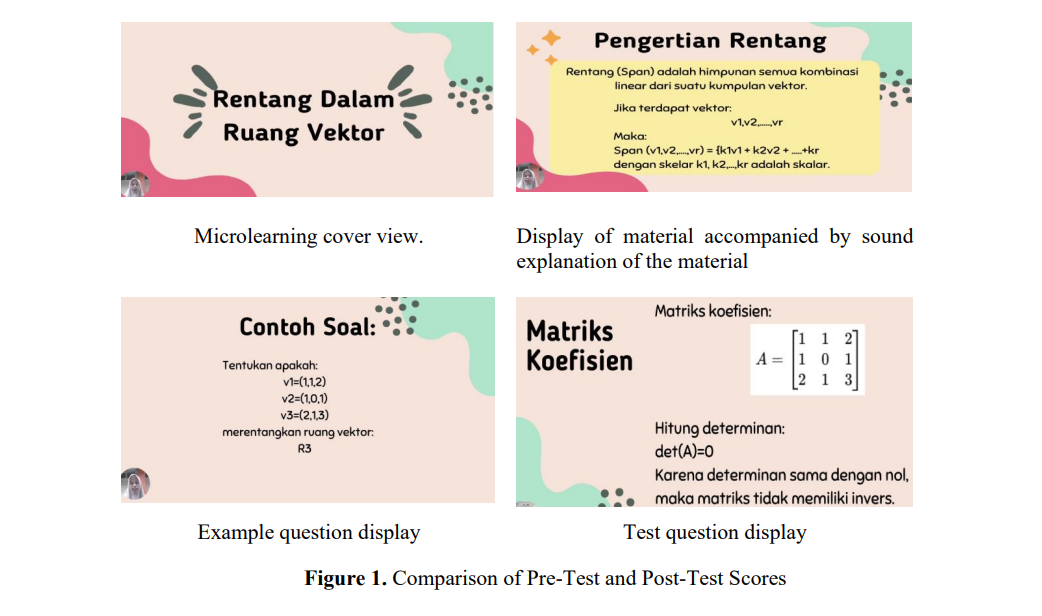
The expansion of social media has opened possibilities for mathematics education through flexible and interactive learning environments. Nevertheless, its use remains insufficiently explored to develop pre-service mathematics teachers’ mathematical creative thinking in Linear Algebra, where abstract vector concepts require opportunities to generate, vary, and justify ideas. This study aimed to develop Instagram-based interactive microlearning for vector material and investigate its validity, practicality, and effectiveness in fostering mathematical creative thinking in terms of fluency, flexibility, and originality. Using a Research and Development approach guided by the ADDIE model, the study comprised Analysis, Design, Development, Implementation, and Evaluation stages. Product validity was examined by three experts, whereas practicality was assessed through a small-group trial with 10 pre-service mathematics teachers and an extended field trial with 20 participants. Effectiveness was evaluated using a quasi-experimental non-equivalent control-group pretest–posttest design involving 40 pre-service mathematics teachers, with 20 assigned to each group. Data were collected through expert validation sheets, student response questionnaires, and mathematical creative thinking tests. The developed media demonstrated high validity based on media (3.50), subject matter (3.58), and learning (3.83) expert assessments, and very high practicality in both the small-group (3.59) and field (3.55) trials. The experimental group increased from 6.28 to 8.58, compared with 5.88 to 7.93 for the control group. The N-Gain was 0.59 versus 0.47, with a significant difference, t . ANCOVA confirmed a significant group effect, , partial η² = .364. These findings establish Instagram-based interactive microlearning as a promising medium for strengthening mathematical creative thinking in Linear Algebra.
References
Adhipertama M, I. M. C., Jampel N., Sudatha W., Jampel, I. N., & Sudatha, I. G. W. (2020). The development of learning video based on micro-learning principle towards science subject in junior high school. Indonesian Journal of Educational Research and Review, 3(3), 132–143. https://doi.org/https://doi.org/10.23887/ijerr.v4i1.30761
Al-Qaysi, N., Mohamad-Nordin, N., & Al-Emran, M. (2020). A systematic review of social media acceptance from the perspective of educational and information systems theories and models. Journal of Educational Computing Research, 57(8), 2085–2109. https://doi.org/10.1177/0735633118817879
Carpenter, J. P., Morrison, S. A., Craft, M., & Lee, M. (2020). How and why are educators using Instagram? Teaching and Teacher Education, 96, 103149. https://doi.org/10.1016/j.tate.2020.103149
Chirove, M., & Ogbonnaya, U. (2026). Mathematical creativity in algebraic tasks of South African secondary school mathematics textbooks. Journal of Honai Math, 9(1), 99–120. https://doi.org///doi.org/10.30862/jhm.v9i1.1059
Conde-Caballero, D., Castillo-Sarmiento, C. A., Ballesteros-Yáñez, I., Rivero-Jiménez, B., & Mariano-Juárez, L. (2023). Microlearning through TikTok in higher education: An evaluation of uses and potentials. Education and Information Technologies, 29, 2365–2385. https://doi.org/10.1007/s10639-023-11904-4
Embaye, T., Bogdanović, Z., & Belay, S. I. (2023). Digital project-based learning for kids: A case study of start-up kids campus. E-Business Technologies Conference Proceedings, 3(1), 276–282. Retrieved from: https://www.ebt.rs/journals/index.php/conf-proc/article/view/180
Fajri, N., Nursalim, M., & Masitoh, S. (2024). Systematic Literature Review: Dampak Teknologi Pendidikan Terhadap Pengembangan Keterampilan Berpikir Kritis, Kreatif, Dan Kolaboratif Pada Pembelajaran Matematika. Jurnal Teknologi Pendidikan, 4(1), 11–24. https://doi.org/10.37304/jtekpend.v4i1.12083
Fang, M., Jandigulov, A., Snezhko, Z., Volkov, L., & Dudnik, O. (2021). New technologies in educational solutions in the field of STEM: The use of online communication services to manage teamwork in project-based learning activities. International Journal of Emerging Technologies in Learning (iJET), 16(24), 4–22. https://doi.org/10.3991/ijet.v16i24.25227
Ferdiani, R. D., Manuharawati, M., & Khabibah, S. (2022). Activist learners' creative thinking processes in posing and solving geometry problem. European Journal of Educational Research, 11(1), 117–126. https://doi.org/10.12973/eu-jer.11.1.117
Ferdiani, R. D., & Pranyata, Y. I. P. (2022). E-modul berbasis STEM PjBL untuk meningkatkan kemampuan berpikir kreatif selama pandemi COVID-19. AKSIOMA: Jurnal Program Studi Pendidikan Matematika, 11(3), 1875–1885. https://doi.org/10.24127/ajpm.v11i3.5141
Ferdiani, R. D. (2025). Optimizing creative thinking skills through STEM-PJBL: The impact of digital modules. Indonesian Journal of Educational Research and Review, 8(2), 313–325. https://doi.org/10.23887/ijerr.v8i2.89707
Giurgiu, L. (2017). Microlearning an evolving elearning trend. Scientific Bulletin, 22(1), 18–23. https://doi.org/10.1515/bsaft-2017-0003
Greenhow, C., & Chapman, A. (2020). Social distancing meet social media: Digital tools for connecting students, teachers, and citizens in an emergency. Information and Learning Sciences, 121(5/6), 341–352. https://doi.org/10.1108/ILS-04-2020-0134
He, K. (2017). A theory of creative thinking: Construction and verification of the dual circulation model. Springer. https://doi.org/10.1007/978-981-10-5053-4
Hudayanti, D. V. F. T. (2022). Pemanfaatan Canva sebagai modul digital interaktif matematika untuk mengoptimalkan pembelajaran jarak jauh. Humantech: Jurnal Ilmiah Multidisiplin Indonesia, 1(7), 853–859. https://doi.org/10.32670/ht.v1i7.1705
Indriyani, O. (2025). Eksplorasi penggunaan platform pembelajaran online Google Classroom dalam mata pelajaran ekonomi. Edunomic Jurnal Pendidikan Ekonomi, 13(1), 8–18. https://doi.org/10.33603/ejpe.v13i1.9860
Ishartono, N., Halili, S. H. B., & Razak, R. B. A. (2025). Exploring factors affecting the preservice mathematics teachers’ use of digital mathematics learning media during online teaching practice. Interactive Learning Environments, 33(5), 3446–3468. https://doi.org/10.1080/10494820.2024.2444532
Kadir, I. A., Machmud, T., Usman, K., & Katili, N. (2022). Analisis kemampuan berpikir kreatif matematis siswa pada materi segitiga. Jambura Journal of Mathematics Education, 3(2), 128–138. https://doi.org/10.34312/jmathedu.v3i2.16388
Laso, Z. O.-, Mantecón, J. M. D., & Sua, C. (2025). Identifying mathematical content in a carpentry Instagram video: A study with pre-service secondary education teachers. Proceedings of the Fourteenth Congress of the European Society for Research in Mathematics Education (CERME14), Free University of Bozen-Bolzano; ERME, Bozen-Bolzano, Italy, 05302395.
Lau, W. W. F. (2018). Relationships between pre-service teachers’ social media usage in informal settings and technological pedagogical content knowledge. EURASIA Journal of Mathematics, Science and Technology Education, 14(12). https://doi.org/10.29333/ejmste/94228
Leong, K., Sung, A., Au, D., & Blanchard, C. (2021). A review of the trend of microlearning. Journal of Work-Applied Management, 13(1), 88–102. https://doi.org/10.1108/JWAM-10-2020-0044
Mangundu, J. (2022). Social media for teaching and learning: A technology acceptance model analysis of preservice teachers’ perceptions during the COVID-19 pandemic. International Journal of Learning, Teaching and Educational Research, 21(5), 182–203. https://doi.org/10.26803/ijlter.21.5.10
Mayer, R. E. (2021). Multimedia Learning (3rd ed.). Cambridge University Press.
Mulenga, E. M., & Marbán, J. M. (2020). Social media usage among pre-service secondary mathematics teachers in Zambia. JRAMathEdu (Journal of Research and Advances in Mathematics Education), 5(2), 130–147. https://doi.org/10.23917/jramathedu.v5i2.9920
OECD. (2023). PISA 2022 results (Volume I): The state of learning and equity in education. OECD Publishing. https://doi.org/10.1787/53f23881-en
Rohmaini, M., Fathurrohman, M., & Syamsuri. (2024). Pengaruh augmented reality pada kemampuan berpikir kreatif siswa: Systematic literature review. JIIP - Jurnal Ilmiah Ilmu Pendidikan, 7(10), 12378–12383. https://doi.org/10.54371/jiip.v7i10.6109
Sagala, K., Naibaho, L., & Rantung, D. A. (2024). Tantangan pendidikan karakter di era digital. Jurnal Kridatama Sains dan Teknologi, 6(1), 1–8. https://doi.org/10.53863/kst.v6i01.1006
Sawarynski, K. E., & Baxa, D. M. (2019). Utilization of an online module bank for a research training curriculum: Development, implementation, evolution, evaluation, and lessons learned. Medical Education Online, 24(1), 1611297. https://doi.org/10.1080/10872981.2019.1611297
Schoevers, E. M., Kroesbergen, E. H., & Kattou, M. (2020). Mathematical creativity: A combination of domain-general creative and domain-specific mathematical skills. The Journal of Creative Behavior, 54(2), 242–252. https://doi.org/10.1002/jocb.361
Setyo, A. A., Ania, Y. S., & Irna, R. (2026). Supporting collaborative and creative mathematical thinking through a multimodal digital textbook: Design and evaluation of a wordwall-integrated learning environment. Journal of Honai Math, 9(1). 25-42. https://doi.org/https://doi.org/10.30862/jhm.v9i1.984
Setiyadi, D., Fortuna, D., & Ramadhan, A. B. (2022). Pemanfaatan video kreatif dan media sosial YouTube sebagai media pembelajaran matematika kelas tinggi. Dawuh Guru: Jurnal Pendidikan MI/SD, 2(1), 31–42. https://doi.org/10.35878/guru.v2i1.344
Silver, E. A. (1997). Fostering creativity through instruction rich in mathematical problem solving and problem posing. Zentralblatt Für Didaktik Der Mathematik, 29(3), 75–80. https://doi.org/10.1007/s11858-997-0003-x
Siswono, T. Y. E. (2011). Level of student's creative thinking in classroom mathematics. Educational Research and Reviews, 6(7), 548–553. https://doi.org/10.5897/ERR.9000226
Sugiyono. (2019). Metode penelitian kuantitatif, kualitatif, dan R&D (2nd ed.). Alfabeta.
Suhardi, & Putri, R. (2023). Peran media sosial WhatsApp dalam pembelajaran matematika pada perilaku siswa kelas V D SD Negeri 1 Kalibalau Kencana Bandar Lampung. Journal Media Public Relations, 3(2), 16–37. https://doi.org/10.37090/jmp.v3i2.1336
Taylor, A., & Hung, W. (2022). The effects of microlearning: A scoping review. Educational Technology Research and Development, 70(2), 363–395. https://doi.org/10.1007/s11423-022-10084-1
Teto, M. S. Y., & Pule, M. L. (2022). Analisis penggunaan media sosial dalam pembelajaran matematika. Asimtot: Jurnal Kependidikan Matematika, 4(1), 13–21. https://doi.org/10.30822/asimtot.v4i1.1931
Widoyoko, E. P. (2012). Teknik penyusunan instrumen penelitian. Pustaka Pelajar.
Downloads
Published
How to Cite
Issue
Section
License
Copyright (c) 2026 Rosita Dwi Ferdiani, Wahyudi Harianto, Tommy Tanu Wijaya, Norudin Siti Wan Aminah Wan

This work is licensed under a Creative Commons Attribution-NonCommercial-ShareAlike 4.0 International License.
License and Copyright Agreement
In submitting the manuscript to the journal, the authors certify that:
- They are authorized by their co-authors to enter into these arrangements.
- The work described has not been formally published before, except in the form of an abstract or as part of a published lecture, review, thesis, or overlay journal. Please also carefully read Journal of Honai Math Posting Your Article Policy at http://journalfkipunipa.org/index.php/jhm/about
- That it is not under consideration for publication elsewhere,
- That its publication has been approved by all the author(s) and by the responsible authorities – tacitly or explicitly – of the institutes where the work has been carried out.
- They secure the right to reproduce any material that has already been published or copyrighted elsewhere.
- They agree to the following license and copyright agreement.
Copyright
Authors who publish with Journal of Honai Math agree to the following terms:
- Authors retain copyright and grant the journal right of first publication with the work simultaneously licensed under a Creative Commons Attribution License (CC BY-NC-SA 4.0) that allows others to share the work with an acknowledgment of the work's authorship and initial publication in this journal.
- Authors are able to enter into separate, additional contractual arrangements for the non-exclusive distribution of the journal's published version of the work (e.g., post it to an institutional repository or publish it in a book), with an acknowledgment of its initial publication in this journal.
- Authors are permitted and encouraged to post their work online (e.g., in institutional repositories or on their website) prior to and during the submission process, as it can lead to productive exchanges, as well as earlier and greater citation of published work.