
Culturally Responsive Mathematics Learning Through Classical Malay Literature: Ethnomathematical Perspectives on Gurindam Dua Belas
DOI:
https://doi.org/10.30862/jhm.v8i3.1148Keywords:
ethnomathematics, Gurindam 12, indegenious knowledge, mathematical logic, set theoryAbstract
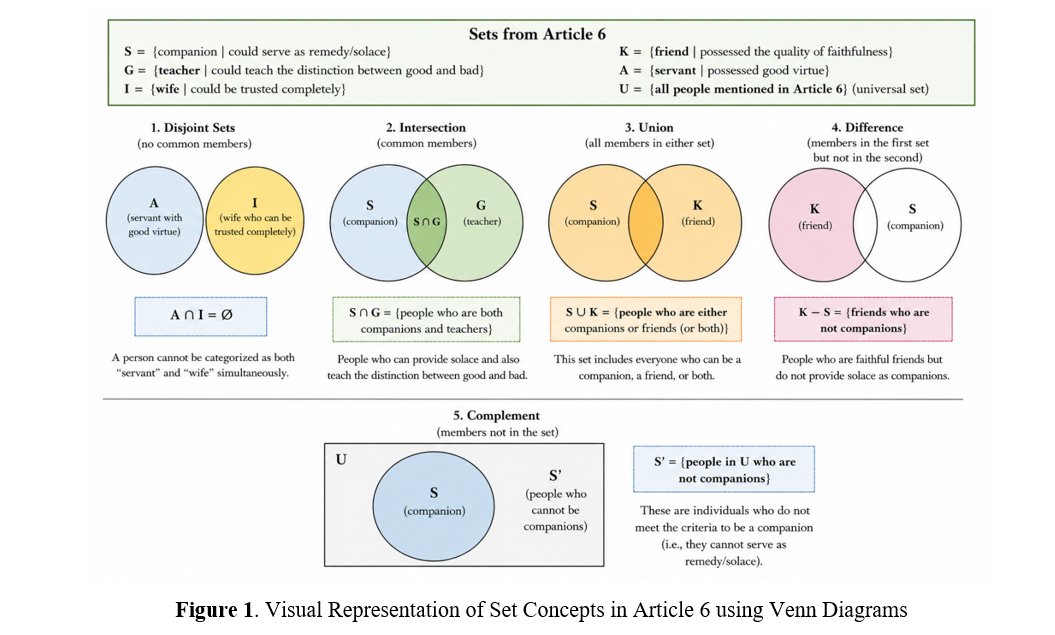
Ethnomathematical exploration of classical Malay literature, particularly Gurindam Dua Belas (Gurindam 12), has remained relatively limited despite its considerable potential to support culturally contextualized mathematics learning. This study aimed to examine the mathematical logic structures and set theory concepts embedded in Gurindam 12 by Raja Ali Haji through an ethnomathematical perspective. The study employed a qualitative interpretive design using a literary hermeneutic approach. Primary data were derived from Articles 5 and 6 of Gurindam 12, while secondary data consisted of scholarly publications on ethnomathematics and mathematics education published between 2014 and 2024. Data analysis was conducted through heuristic reading, thematic pattern identification, hermeneutic interpretation, and triangulation with formal mathematical theory. The findings revealed that Article 5 contained inferential structures analogous to mathematical implication logic (p → q), represented through conditional moral relationships, whereas Article 6 reflected classificatory structures parallel to foundational concepts in set theory, including sets, subsets, and membership criteria. The integration of Gurindam 12 into mathematics education offers a culturally responsive ethnomathematical approach that may enhance conceptual understanding, cultural awareness, and positive mathematical dispositions. This study contributes to ethnomathematics literature by demonstrating that classical Malay literature constitutes a meaningful pedagogical resource for bridging indigenous knowledge systems with universal mathematical concepts.
References
Aharoni, R. (2014). Mathematics, poetry and beauty. Journal of Mathematics and the Arts, 8(1-2), 5-12. https://doi.org/10.1080/17513472.2014.943490
Arisetyawan, A., Suryadi, D., Herman, T., & Rahmat, C. (2014). Study of ethnomathematics: A lesson from Baduy culture. International Journal of Education and Research, 2(10), 681–688.
Ausubel, D. P. (2000). The acquisition and retention of knowledge: A cognitive view. Springer.
Capraro, R. M., & Capraro, M. M. (2018). Integrating mathematics and literature: Teaching and learning mathematics using children's literature. Springer.
Chahine, I. C., & Allexsaht-Snider, M. (2019). Indigenous knowledge in mathematics education: International perspectives. In P. Ernest (Ed.), The philosophy of mathematics education today (pp. 283-298). Springer.
Copi, I. M., Cohen, C., & McMahon, K. (2019). Introduction to logic (15th ed.). Routledge.
D’Ambrosio, U. (2001). Ethnomathematics: Link between traditions and modernity. Kluwer Academic Publishers. https://doi.org/10.1007/0-306-47203-8
D'Ambrosio, U. (2016). An overview of the history of ethnomathematics. In M. Rosa, L. Shirley, M. E. Gavarrete, & W. V. Alangui (Eds.), Ethnomathematics and its diverse approaches for mathematics education (pp. 5-10). Springer.
D'Ambrosio, U. (2020). Ethnomathematics: A response to the changing role of mathematics in society. Philosophy of Mathematics Education Journal, 36, 1-16.
Devlin, K. (2014). Sets, functions, and logic: An introduction to abstract mathematics (3rd ed.). Chapman and Hall/CRC.
Enderton, H. B. (2015). A mathematical introduction to logic (2nd ed.). Academic Press.
Endraswara, S. (2023). Puisi angka Jawa sebagai indigenous knowledge dalam perspektif etnomatematika sastra [Javanese numerical poetry as indigenous knowledge in the perspective of literary ethnomathematics]. Aksara, 35(2), 177-189. https://doi.org/10.29255/aksara.v35i2.4171.177-189
Fouze, A. Q., & Amit, M. (2017). Development of mathematical thinking through integration of ethnomathematics folklore game in math instruction. Eurasia Journal of Mathematics, Science and Technology Education, 14(2), 617-630. https://doi.org/10.12973/ejmste/80626
Growney, J. S. (2020). Mathematics in poetry. Journal of Humanistic Mathematics, 10(1), 88-100. https://doi.org/10.5642/jhummath.202001.07
Jablonka, E. (2016). Mathematics education and culture: A contemporary moral dilemma. In P. Ernest, B. Sriraman, & N. Ernest (Eds.), Critical mathematics education: Theory, praxis and reality (pp. 47-66). Information Age Publishing.
Karaali, G., & Sriraman, B. (2021). Mathematics and humanities: An interdisciplinary dialogue. ZDM Mathematics Education, 53(3), 479-489. https://doi.org/10.1007/s11858-021-01269-8
Lakoff, G., & Núñez, R. E. (2000). Where mathematics comes from: How the embodied mind brings mathematics into being. Basic Books.
Liaw, Y. F. (2013). Sejarah kesusastraan Melayu klasik [History of classical Malay literature]. Yayasan Pustaka Obor Indonesia.
Lipschutz, S., & Lipson, M. L. (2017). Schaum's outline of discrete mathematics (4th ed.). McGraw-Hill Education.
Mahamod, Z., Embi, M. A., & Yusoff, N. M. R. N. (2015). Strategi pembelajaran Bahasa Melayu dalam kalangan pelajar [Malay language learning strategies among students]. Penerbit Universiti Kebangsaan Malaysia.
Meaney, T., Trinick, T., & Fairhall, U. (2016). Collaborating to meet language challenges in indigenous mathematics classrooms. Springer.
Patel, A. D. (2014). Music, language, and the brain. Oxford University Press.
Presmeg, N. C. (2006). Research on visualization in learning and teaching mathematics. Handbook of Research on the Psychology of Mathematics Education, 205–235. https://doi.org/10.1163/9789087901127_010
Ricoeur, P. (2016). Hermeneutics and the human sciences: Essays on language, action and interpretation. Cambridge University Press.
Risdiyanti, I., & Prahmana, R. C. I. (2020). Ethnomathematics: Exploration in Javanese culture. Journal of Physics: Conference Series, 1470(1), Article 012072. https://doi.org/10.1088/1742-6596/1470/1/012072
Rosa, M., & Orey, D. C. (2016). Humanizing mathematics through ethnomodeling. Journal of Humanistic Mathematics, 6(2), 3-22. https://doi.org/10.5642/jhummath.201602.03
Rosa, M., & Orey, D. C. (2016). Humanizing mathematics through ethnomathematics. Journal of Humanistic Mathematics, 6(2), 62–85. https://doi.org/10.5642/jhummath.201602.06.
Rosen, K. H. (2018). Discrete mathematics and its applications (8th ed.). McGraw-Hill Education.
Schiro, M. (2020). Using children's literature to teach mathematics. Teachers College Press.
Shirley, L., & Palhares, P. (2020). Ethnomathematics and its diverse approaches for mathematics education. ZDM Mathematics Education, 52(6), 1101-1113. https://doi.org/10.1007/s11858-020-01192-2
Tan, K. C., & Ang, K. C. (2016). A framework for mathematical modelling in school curriculum. International Journal of Mathematical Education in Science and Technology, 47(2), 198-211. https://doi.org/10.1080/0020739X.2015.1076533
Utami, N. W., Sayuti, S. A., & Jailani, J. (2018). Math and Mate in Javanese wisdom: A conceptual framework for indigenous mathematics. International Electronic Journal of Mathematics Education, 14(1), 201-210. https://doi.org/10.12973/iejme/3984
Valdes, M. (1987). Phenomenological hermeneutics and the study of literature. University of Toronto Press.
Downloads
Published
How to Cite
Issue
Section
License
Copyright (c) 2026 Asmaul Husna, Ratu Ilma Indra Putri, Zulkardi, Jaya Dwi Putra

This work is licensed under a Creative Commons Attribution-NonCommercial-ShareAlike 4.0 International License.
License and Copyright Agreement
In submitting the manuscript to the journal, the authors certify that:
- They are authorized by their co-authors to enter into these arrangements.
- The work described has not been formally published before, except in the form of an abstract or as part of a published lecture, review, thesis, or overlay journal. Please also carefully read Journal of Honai Math Posting Your Article Policy at http://journalfkipunipa.org/index.php/jhm/about
- That it is not under consideration for publication elsewhere,
- That its publication has been approved by all the author(s) and by the responsible authorities – tacitly or explicitly – of the institutes where the work has been carried out.
- They secure the right to reproduce any material that has already been published or copyrighted elsewhere.
- They agree to the following license and copyright agreement.
Copyright
Authors who publish with Journal of Honai Math agree to the following terms:
- Authors retain copyright and grant the journal right of first publication with the work simultaneously licensed under a Creative Commons Attribution License (CC BY-NC-SA 4.0) that allows others to share the work with an acknowledgment of the work's authorship and initial publication in this journal.
- Authors are able to enter into separate, additional contractual arrangements for the non-exclusive distribution of the journal's published version of the work (e.g., post it to an institutional repository or publish it in a book), with an acknowledgment of its initial publication in this journal.
- Authors are permitted and encouraged to post their work online (e.g., in institutional repositories or on their website) prior to and during the submission process, as it can lead to productive exchanges, as well as earlier and greater citation of published work.




